
Amid the raucous revelry of Carnival week, a technology researcher fleeing a mysterious past arrives in Recife. He soon realizes the city is far from the refuge he seeks. A film by Kleber Mendonça Filho, starring Robson Andrade, Rubens Santos, Licínio Januário, Joálisson Cunha, Marcelo Valle, Fabiana Pirro, Hermila Guedes, Márcio de Paula, Gregorio Graziosi, Buda Lira, Suzy Lopes, Erivaldo Oliveira, Fafá Dantas, Geane Albuquerque, Isadora Ruppert, Wilson Rabelo, Aline Marta, João Vitor Silva, Alice Carvalho, Luciano Chirolli, Udo Kier, Isabél Zuaa, Maria Fernanda Candido, Thomás Aquino, Gabriel Leone, Roney Villela, Kaiony Venâncio, Carlos Francisco, Ítalo Martins, Igor de Araújo, Robério Diógenes, Enzo Nunes, Tânia Maria, Laura Lufési, and Wagner Moura.
O AGENTE SECRETO
L’AGENT SECRET
THE SECRET AGENT
Kleber Mendonça Filho
(2025)
NOSSA HISTÓRIA SE PASSA NO BRASIL DE 1977. UMA ÉPOCA CHEIA DE PIRRAÇA…
During the 1977 carnival holiday, Armando (Wagner Moura) is driving to Recife when he stops to refuel at a roadside gas station. He grows uneasy when he notices a body lying motionless on the ground, covered with a large piece of cardboard. Not wanting to get involved, his instinct is to flee.

But before he can drive off, the attendant (Joálisson Cunha) walks out and greets him, asking if he needs gas. Seeing Armando’s gaze fixed on the corpse, the attendant calmly assures him it’s nothing to worry about. He explains that the previous Sunday, a man came with a knife, trying to steal some oil cans, prompting the night shift guard, Rivanildo, to take him out with a 12-gauge shotgun.
Carnival in Recife, Brazil, is a vibrant street festival centered in Recife and nearby Olinda, featuring high-energy music, dance, and parades over about six days before Lent. Olinda emerged as a prime carnival hub for everyday revelers starting in 1977, with spontaneous bands at every corner drawing families across generations, often weaving in political and social themes via costumes and music. This grassroots vibe contrasted with more structured events, building on frevo’s brass-band marches and maracatu’s Afro-Brazilian roots that had evolved since the 19th century. Amid national political thaw, Recife’s 1977 carnival pulsed with frevo dances, military-band processions, and community energy, setting the stage for UNESCO-recognized traditions. It was free-spirited and participatory, fueling Recife’s rise as a top carnival alongside Rio and Salvador. Carnival in Recife during the 1977 era marked a pivotal shift toward its modern street-party dominance, especially as Brazil transitioned from military dictatorship toward openness.

While cleaning the windshield, the attendant shares more of the story. The body has been lying there since Sunday night, right during carnival weekend. Rivanildo called the owners, but got no answer, so he panicked and ran off because he didn’t want to get caught for killing someone. Now the attendant is stuck dealing with this mess alone because he can’t afford to lose his job. When Armando asks if he reported it to the cops, the attendant says they did, and the police told them they’d come by on Ash Wednesday, which is tomorrow, because they’re too swamped with carnival.
Ash Wednesday marks the official end of Carnival celebrations worldwide, including in Recife, transitioning from festive excess to the solemn 40-day Lenten season of penance and reflection. In 1977, with Ash Wednesday on 16 February, it concluded the week’s street parties, frevo dances, and emerging block parades like precursors to Galo da Madrugada, as revelers shifted to church services for ashes symbolizing repentance.

Moments later, a federal motorway police car arrives at the gas station. The attendant thinks they’ve come to investigate the body, but the car drives right past it. One of the officers signals for Armando to stay where he is. Two officers get out. One remains with the attendant while the other walks straight to Armando’s car and asks for his license and registration. After checking the documents and finding everything in order, he asks to see the fire extinguisher.

As Armando reaches for it, the officer (Márcio de Paula) tells him to step out so he can inspect the vehicle himself. He searches the car but finds nothing. Then he asks if Armando would like to contribute to the Force’s carnival fund. Armando says he’s been on the road for three days and just spent his last money on gas. Instead, he offers some leftover cigarettes, which the officer takes before letting him go.

Meanwhile, police chief Euclides Cavalcanti (Robério Diógenes) and his right-hand man Sérgio (Igor de Araújo) receive word from Euclides’ stepson Arlindo (Ítalo Martins) that the severed leg found inside a dead shark might belong to a punk they murdered last week. They visit the local university where the shark is being examined.

Dr. Inês (Fabiana Pirro) tells them the shark washed up roughly 150 meters off Candeias beach on Sunday. Time is of the essence since they lack a working refrigerator to keep it from decomposing. Her team found the leg during the dissection. She started to extract it but thought better of it and contacted the authorities instead.



Brazil. 1977. The Secret Agent.
—
A film by Kleber Mendonça Filho, starring Wagner Moura, Alice Carvalho, Gabriel Leone, Isabél Zuaa, Maria Fernanda Candido, Udo Kier, Robson Andrade, Rubens Santos, Licínio Januário, Joálisson Cunha, Marcelo Valle, Fabiana Pirro, Hermila Guedes, Márcio de Paula, Gregorio Graziosi, Buda Lira, Suzy Lopes, Erivaldo Oliveira, Fafá Dantas, Geane Albuquerque, Isadora Ruppert, Wilson Rabelo, Aline Marta, João Vitor Silva, Luciano Chirolli, Thomás Aquino, Roney Villela, Kaiony Venâncio, Carlos Francisco, Ítalo Martins, Igor de Araújo, Robério Diógenes, Enzo Nunes, Tânia Maria, and Laura Lufési.
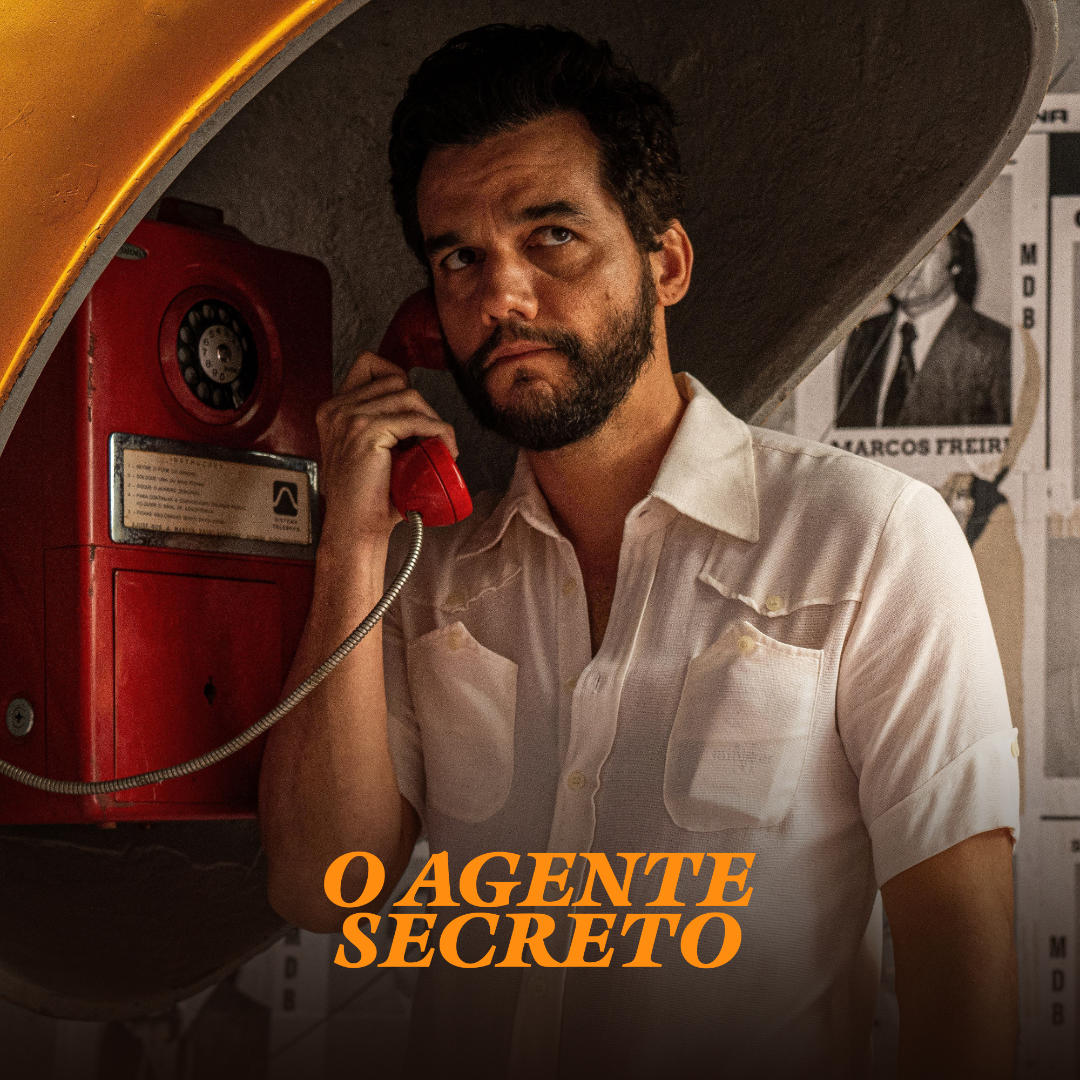
Written and directed by Brazilian filmmaker Kleber Mendonça Filho, O Agente Secreto is a historical thriller following a former university researcher caught in political turmoil. Forced to flee persecution, he takes refuge in the city of Recife.
Much like his previous film BACURAU, this story unfolds at a deliberate, almost excruciatingly slow pace, with a crowd of characters surrounding the protagonist, Armando Solimões. Armando is a former professor with a mysterious past. His wife Fátima, allegedly died of pneumonia, but we never see her getting sick or dying. We only hear about it from Armando when he tells his son Fernando.
I absolutely love the sequence where the severed leg reanimates and attacks people in a public park at night. Of course, within the movie’s reality, this is just a newspaper cover-up, though the leg does actually go missing from the morgue. They could’ve just had characters read about the fake news, but visualizing it elevates the scene to a sublime level of entertainment.
The final 30 minutes are exhilarating and thrilling. Once the hitman begins following Armando’s father-in-law Alexandre, I was on the edge of my seat. I was convinced the hitman had been hired to kill him just to tie up loose ends, and I found myself rooting hard for his survival since he’s such an innocent man. The situation spirals out of control, and several people meet violent, brutal deaths.
Not to nitpick, but I feel like adult Fernando should have been played by a different actor. I get that he’s Armando’s son, but seeing him look exactly like his father 40 years later was just too unsettling for me. That said, Wagner Moura gives an outstanding performance as Armando. Interestingly, we never witness his death firsthand. We only see newspaper headlines and a photograph. I found myself hoping he’d somehow survived, but it seems he didn’t.

O AGENTE SECRETO premiered at Festival de Cannes on 18 May 2025 in the main competition where it won Prix d’interprétation masculine for Wagner Moura and Prix de la mise en scène for Kleber Mendonça Filho. The film was theatrically released in Brazil on 6 November by Vitrine Filmes.
Prix d’interprétation masculine is the Best Actor Award at the Cannes Film Festival. It honors the most outstanding male acting performance from films in the official competition, selected by the jury since 1946. The prize has been awarded annually, with occasional ties or group awards, such as to the entire male cast of Indigènes in 2006.
Prix de la mise en scène is the Best Director Award at the Cannes Film Festival. It recognizes the most outstanding directorial achievement in a feature film from the official competition, awarded annually by the jury. The prize dates back to the festival’s early years, with winners like Ingmar Bergman (1958 for Au seuil de la vie) and the Dardenne brothers (2019 for Le Jeune Ahmed). Recent recipients include Park Chan-wook (2022, Decision to Leave) and Trần Anh Hùng (2023, La Passion de Dodin Bouffant).