

The untold story of love and loss that inspired the creation of Shakespeare’s timeless masterpiece. A film by Chloé Zhao, starring Jessie Buckley, Paul Mescal, Emily Watson, Joe Alwyn, Jacobi Jupe, Olivia Lynes, Justine Mitchell, David Wilmot, Louisa Harland, Freya Hannan-Mills, Bodhi Rae Breathnach, and Noah Jupe.
HAMNET
Chloé Zhao
(2025)

To pay off his father’s debts, a young English playwright (Paul Mescal) takes a job as a Latin tutor. During a lesson, he is captivated by the sight of Agnes Hathaway (Jessie Buckley), a free-spirited young woman returning from the forest with her pet hawk. Abandoning his students, he follows her into a barn.

Agnes finds herself inexplicably drawn to him. Gifted with a supernatural ability to read people and glimpse their futures through touch, she experiences a powerful vision when their hands meet. After a sudden kiss, she reveals her name and abruptly flees, warning him that he must never see her again.

Upon returning home, Agnes lies to her stepmother Joan (Justine Mitchell) about where she’s been, claiming she was in the field helping her brother Bartholomew (Joe Alwyn) with an unwell newborn lamb. Joan says she also went to the field but didn’t see Agnes there, implying that she knows Agnes is lying. Agnes insists she was there and presses Bartholomew to back her up. Being a good brother, Bartholomew corroborates her story. Changing the subject, Joan asks if Agnes has seen the new Latin tutor, mentioning that the boys said he ran out of the classroom and never returned.

Meanwhile, the Latin tutor’s father John (David Wilmot) is visibly upset when his son arrives home hours late for supper. His mother Mary (Emily Watson) asks how the lessons at Hewlands went, and he jokes that the boys are no scholars. John bristles at his son speaking ill of the Hewlands boys, saying they’ll be more of a man than his son will ever be.

John resents that his son has no interest in the family glove-making business, choosing instead to chase dreams of writing and theater. Stung, the son reminds John that he came home to tutor those boys and pay off his father’s debts to the Hathaway family. When Mary asks if he’s met the rest of the family at Hewlands, particularly the eldest daughter, he insists he only met the mother. Mary then warns him, revealing that the girl is rumored to be the child of a forest witch.

The following day, the Latin tutor finds Agnes in the forest and presents her with a new hawk glove. But Agnes doesn’t accept it, saying she already has one. Agnes asks why he keeps staring at her. He stammers, unable to give a clear answer, and admits that speaking with people is sometimes difficult for him. Softening, Agnes suggest him to tell her a story instead. He asks what she wants to hear, and she answers: “Something that moves you.”

He chooses to share the story of Orpheus and Eurydice.
Orpheus, son of the muse Calliope and Apollo, received a magical lyre from his father and became unmatched in music. He fell deeply in love with the beautiful nymph Eurydice, and they married in bliss, though the god Hymen warned their happiness would be fleeting. Soon after their marriage, Eurydice died from a venomous snakebite. Filled with grief, Orpheus journeyed to the underworld to take her back, charming the ferryman Charon, the dog Cerberus, and the underworld itself with his lyre. Hades and Persephone, moved to tears, agreed to release Eurydice on one condition: Orpheus must walk ahead without looking back until they reached the sunlight. As they begin their ascent, Orpheus couldn’t hear her footsteps, so he listens. But all he could hear was the sound of his heartbeat. And the rest was silence. And as he approached the gates of the underworld, he couldn’t contain himself any longer. He turned around to look at her, and she was trapped in the underworld forever.



We found love in a hopeless place.
—
A film by Chloé Zhao, starring Jessie Buckley, Paul Mescal, Emily Watson, Joe Alwyn, Jacobi Jupe, Olivia Lynes, Justine Mitchell, David Wilmot, Louisa Harland, Freya Hannan-Mills, Bodhi Rae Breathnach, and Noah Jupe.
By the end of the tale, Agnes is visibly moved and finally lets her guard down. She reveals that when she touches someone, she can see into them. He asks what she saw when she touched him. Agnes describes a landscape: spaces, caves, cliff tops, tunnels, oceans. The deep, dark void. Undiscovered countries. Drawn together by this connection, they kiss. They begin a secret romance, well aware that their families would never approve of the match.

Soon, Agnes becomes pregnant. The Latin tutor is caught off guard when he returns home one day to find Agnes and her brother Bartholomew waiting for him. Visibly upset, his mother demands to know if it’s true that he is the father of Agnes’s child. When he admits that it is, his mother declares that she will not give her consent for him to marry Agnes, convinced that her son has been bewitched by her.

John calmly suggests to Bartholomew that they can come to an agreement, adding that he imagines Bartholomew is eager to see his sister married. Bartholomew fires back that John would surely rather not see his son hauled before the bawdy court, despite his son’s claim that the two are already handfasted.

Later, Agnes persuades Bartholomew to let her marry the glover’s son, telling him there is more inside that man than any she has ever met. She reminds her brother of what their mother used to tell them whenever they were afraid or uncertain: “To live with our hearts open. To shut it not in the dark but to turn it to the sun.”

After the marriage, Agnes gives birth to their first daughter, Susanna, alone in the woods. As time passes, the glover’s son grows increasingly restless, forced by his father into what he considers tedious work making gloves. Tension builds as he loses the will to write, his inspiration slowly fading.

Seeing her husband in torment, Agnes goes to Bartholomew. She tells him that London is where the world gathers, and that perhaps her husband could go there to expand his father’s business. But the truth is she knows that staying here will crush him and that he needs distance from his father. She fears that if he stays, she will lose him altogether. Knowing that John will listen to Bartholomew, she urges him to be the one to propose the idea. Agnes tells Bartholomew she won’t be going with her husband, as she is expecting another child by summer’s end. Several months after her husband leaves for London, Agnes gives birth to twins: Hamnet and Judith.

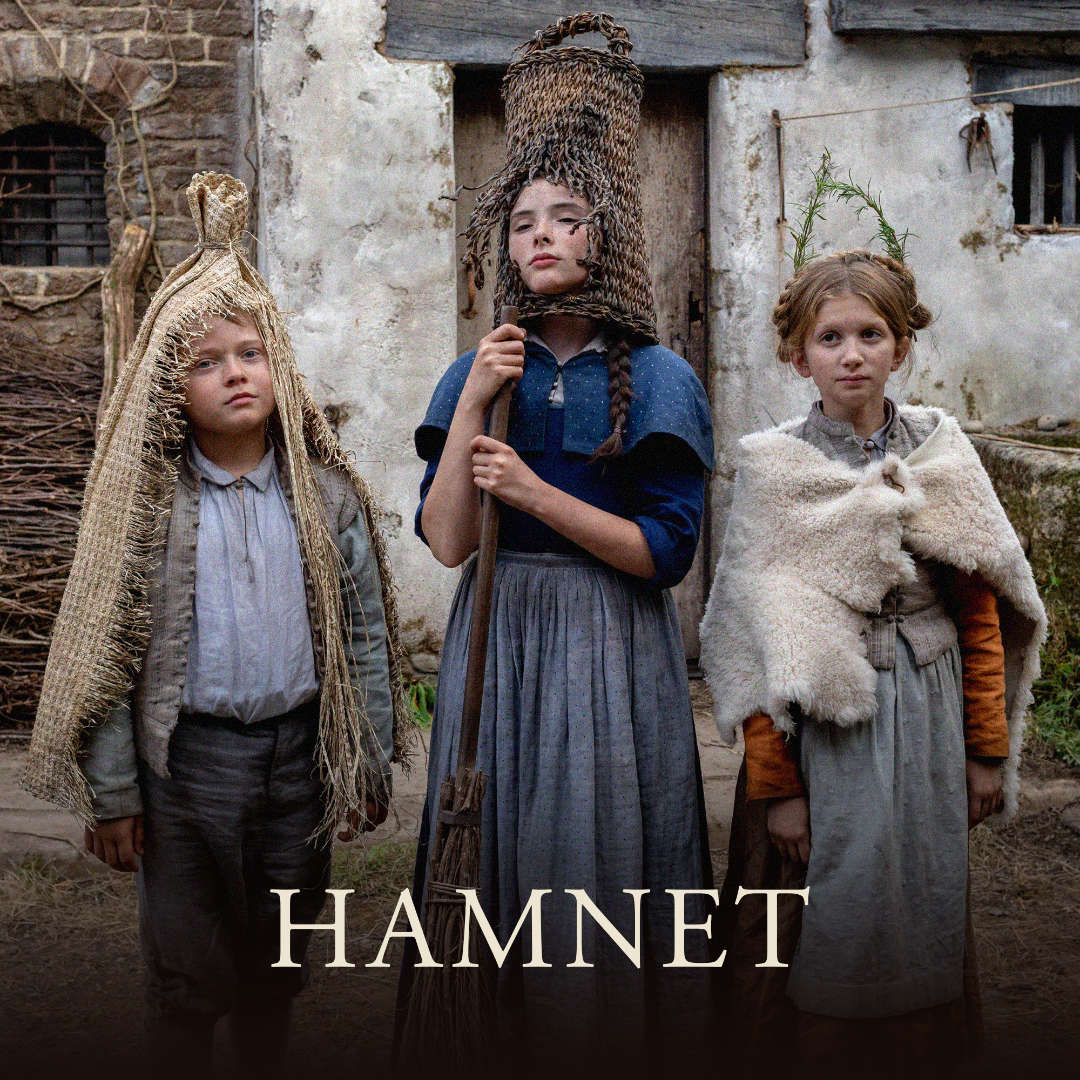
Many years later, Hamnet (Jacobi Jupe) and Judith (Olivia Lynes) are inseparable. Whenever their father comes home, they delight in switching places, swapping clothes to see if he can tell them apart. Hamnet comes alive when his father is around, and is crushed each time his father announces he must return to London. He promises to be brave while his father is away. When her husband, now fairly well-known in theater, tells her he has been looking for a house for them in London, Agnes raises her concern about Judith, who has been frail since birth and may not survive the London climate. Understanding her concern, he reveals that he has decided to look for land outside Stratford for Agnes and the children instead.

Back in London, the playwright watches as the bubonic plague tightens its grip on the city, claiming lives at an alarming rate. Though records from this period are not well-documented, a significant outbreak between 1592 and 1593 is estimated to have killed over 15,000 people in London alone, with nearly 5,000 more deaths in the surrounding areas.
Bubonic plague in 1596 featured rapid onset symptoms like high fever, chills, headaches, vomiting, and painful swellings called buboes in the lymph nodes of the groin, armpits, or neck. Victims often suffered delirium, muscle cramps, acral necrosis (blackened skin on extremities), and gangrenous tissue decay, with death typically occurring within days to a week if untreated. In England, the disease spread via rat fleas carrying Yersinia pestis, exacerbated by poor hygiene and overcrowding; survival odds hovered around 50% for bubonic form, far worse for pneumonic or septicemic variants.

At home, Agnes is horrified to discover that Judith has contracted the pestilence. She draws on every herbalist remedy her mother ever taught her, trying everything she knows. Nothing works. Mary tries to comfort her, telling her she has done all she can. But Agnes refuses to give up and will not let her child slip away. That night, exhausted and overwhelmed, Agnes falls asleep. Hamnet quietly slips into Judith’s bed, lying in her place in hopes of tricking death into taking him instead. Come morning, Judith’s fever has miraculously broken. But Hamnet has fallen gravely ill. Agnes fights desperately to save him. It is no use. His health deteriorates quickly, and he dies in agony.

Agnes’s husband rushes home as soon as he receives the news, expecting the worst. He is relieved to find Judith alive and seemingly well, but is devastated to learn that his son is dead. Agnes blames herself for not seeing Hamnet’s death coming, having always believed it would be Judith who would be taken. Her husband tries to comfort her, telling her there was nothing anyone could have done and that she did everything she could. Through tears, Agnes tells him he has no idea what she truly feels because he wasn’t here when it happened.

The next day, her husband prepares to return to London. Agnes asks how he can possibly leave at a time like this. He tells her gently that the world does not stand still. People are waiting for him. The season is about to begin, and his company will be returning from Kent any day now.

Their marriage grows strained in the wake of Hamnet’s death, as Agnes grieves alone while her husband remains in London. Before long, Agnes and their daughters move into the biggest house in Stratford, bought for them by her husband. Agnes knows little of what her husband does in the theater, so she is caught off guard when Joan pays her a visit and asks how he is coping with his father’s passing. Agnes tells her he is well and busy preparing a comedy. Joan corrects her, saying his new play is no comedy. It is a tragedy, and everyone in town is talking about it. She then hands Agnes a playbill for a production called Hamlet.

After Joan leaves, Agnes confides in Susanna (Bodhi Rae Breathnach), upset that her husband hasn’t spoken to them in months. How could he not tell them about a play bearing their son’s name? Susanna piques her curiosity when she asks if Agnes has ever wondered what the play is actually about.

Agnes and Bartholomew travel to London to see her husband, but upon arrival, he is nowhere to be found. A boy notices them and asks who they are looking for. Bartholomew tells him they are family from Stratford. The boy points them up the stairs, saying he lives in the attic. Agnes is struck to find that her husband lives and works in a single room, far smaller than anything in their house back in Stratford. Bartholomew can’t help but wonder why a man who owns the largest house in Stratford would choose to live this way. For Agnes, the discovery is unsettling. She begins to wonder if she had misread him all along, assuming he was living lavishly in London.

Agnes and Bartholomew attend a performance of Hamlet at the Globe Theatre, hoping to find her husband among the company. Agnes grows increasingly agitated as she hears her dead son’s name spoken aloud on stage. And before long she begins shouting, disturbing the audience around her. She is startled when the actor (Noah Jupe) portraying Hamlet steps out, bearing an uncanny resemblance to what her son might have looked like had he lived to adulthood. Then her husband appears on stage as the ghost of Hamlet’s father. In that moment, Agnes understands. The play is his tribute to Hamnet.

Whether ’tis nobler in the mind to suffer
The slings and arrows of outrageous fortune,
Or to take arms against a sea of troubles
And by opposing end them. To die—to sleep,
No more; and by a sleep to say we end
The heart-ache and the thousand natural shocks
That flesh is heir to: ’tis a consummation
Devoutly to be wish’d. To die, to sleep;
To sleep, perchance to dream—ay, there’s the rub:
For in that sleep of death what dreams may come,
When we have shuffled off this mortal coil,
Must give us pause—there’s the respect
That makes calamity of so long life.
For who would bear the whips and scorns of time,
Th’oppressor’s wrong, the proud man’s contumely,
The pangs of dispriz’d love, the law’s delay,
The insolence of office, and the spurns
That patient merit of th’unworthy takes,
When he himself might his quietus make
With a bare bodkin? Who would fardels bear,
To grunt and sweat under a weary life,
But that the dread of something after death,
The undiscovere’d country, from whose bourn
No traveller returns, puzzles the will,
And makes us rather bear those ills we have
Than fly to others that we know not of?
Thus conscience doth make cowards of us all,
And thus the native hue of resolution
Is sicklied o’er with the pale cast of thought,
And enterprises of great pith and moment
With this regard their currents turn awry
And lose the name of action.

Directed by Chinese filmmaker Chloé Zhao from a screenplay she cowrote with Maggie O’Farrell, HAMNET is a historical drama based on O’Farrell’s 2020 novel. The film follows an English playwright and his wife as they navigate the devastating loss of their son during a plague outbreak.
Maggie O’Farrell’s HAMNET is a historical novel that imagines the life of a playwright’s family, centering on the death of their son from the bubonic plague. The story alternates between the plague’s spread from Venice to Stratford-upon-Avon and the intimate family dynamics, particularly the grief of the mother and her strained marriage to her playwright husband. It explores themes of loss, resilience, and the blurred line between fact and fiction. The novel won the Women’s Prize for Fiction and the National Book Critics Circle Award for Fiction in 2020. It also won the Dalkey Literary Awards Novel of the Year in 2021.
It’s mesmerizing.
Jacobi Jupe and Emily Watson are extraordinary!
One of the most brilliant aspects of the screenplay is that the name William Shakespeare is spoken only once in the entire film, in the final act. At no point before this do we hear any character speak his name, first or last, making the moment all the more powerful when it finally arrives.

HAMNET premiered at the Telluride Film Festival on 29 August 2025. The film was theatrically released in the United States and Canada on 26 November.