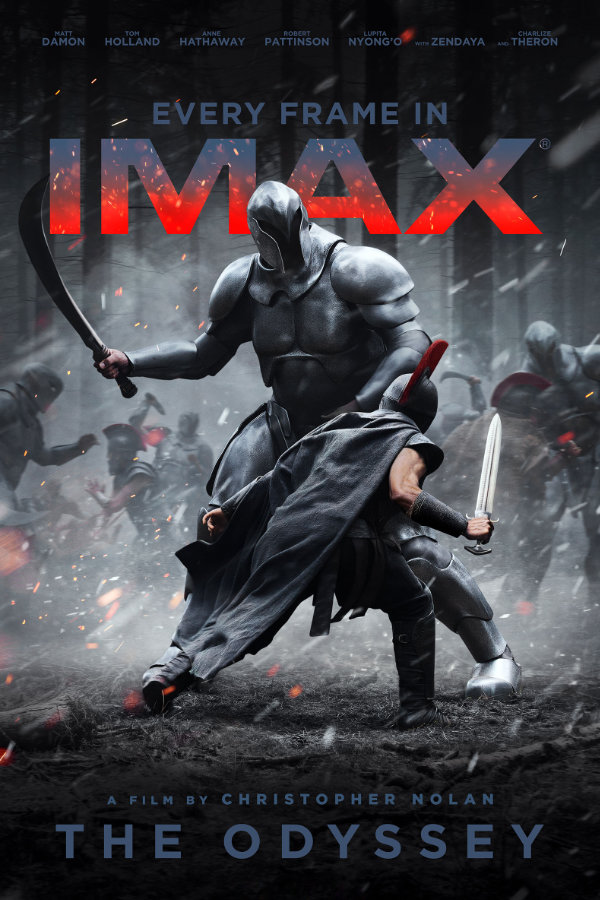


Based on Homer’s ancient Greek epic poem. A film by Christopher Nolan, starring Matt Damon, Tom Holland, Anne Hathaway, Robert Pattinson, Lupita Nyong’o, Zendaya, Charlize Theron, Travis Scott, Corey Hawkins, Jarreth Merz, Niko Nicotera, Elliot Page, Shiloh Fernandez, Rafi Gavron, Elyes Gabel, Iddo Goldberg, Jamie Harris, John Ales, Raimy Lang, Mason Cufari, John Leguizamo, Mia Goth, Ryan Hurst, Kate Fuglei, Benny Safdie, Adam Croasdell, Mickey Shilowich, Katerina Antemel Mpa, Himesh Patel, Jovan Adepo, Andrew Howard, Josh Stewart, Logan Marshall-Green, Nick Tarabay, Jon Bernthal, Jimmy Gonzales, Jesse Garcia, Ryan de Quintal, Will Yun Lee, Anthony Molinari, Stephen Murphy, Matt Lasky, Ian Casselberry, Sean Avery, Yannis Kokiasmenos, Bill Irwin, Maurice Compte, Tyler Beardsley, Daniel Dorr, Xavier Brown, Jessie Cohen, Chess Lopez, Craig Gellis, Artoun Nazareth, Chris Riggi, Barnaby Nolan, John King, Samantha Morton, James Remar, Brian Vernel, Michael Vlamis, and Kamden Riley.
THE ODYSSEY
Christopher Nolan
(2026)
The Trojan War was a legendary conflict ignited by a divine dispute over a golden apple inscribed “Kallistēi” (To the Fairest). Forced to choose the rightful owner among three powerful goddesses, Prince Paris of Troy awarded the apple to Aphrodite, who promised him the heart of the most beautiful woman in the world. The prize was Helen, the queen of Sparta, who was already married to King Menelaus.
Under the goddess’s protection, Paris sailed to Sparta and stole Helen away in the dead of night while her husband was absent. When Menelaus returned to find his wife gone, he turned to his elder brother, King Agamemnon of Mycenae, to rally the Greeks. They sent emissaries across the sea, calling upon former suitors including King Odysseus of Ithaca to honor their sacred oath to defend Helen’s marriage. Launching a fleet of a thousand ships, this massive coalition laid siege to Troy for a decade, yet they could not breach its impenetrable walls.
After ten years of failed assaults, Odysseus devises an infamous deception. The Greeks construct a colossal wooden horse, concealing a squad of warriors inside, including Odysseus himself. The rest of the army sails away to fake a full retreat, leaving the horse on the beach with a single soldier named Sinon. Believing the lie he was fed, Sinon thinks the horse is a genuine offering to Athena for a safe voyage home.
Days later, Trojan scouts discover the horse and fatally wound Sinon. With his dying breath, Sinon gasps out the false story. Convinced by a dying man’s final words, the Trojans mobilize hundreds of civilians to haul the horse back to the city of Troy.
The Trojans drag the horse inside the city walls, placing it in front of the Athenaion (the sanctuary of Athena), and celebrate as if the war is over. That night, when the city falls quiet, Odysseus and his hidden warriors slip from the wooden belly. They move toward the impenetrable gates, silently executing Trojan guards along the way. The tension escalates when a guard spots them and sounds the alarm.
Trojan soldiers swarm the intruders, but Odysseus and his squad hold the line with a desperate barrage of arrows. Behind them, a handful of men scramble to the gates, throwing their weight against two large wooden wheels mounted on either side. They furiously crank the wheels, engaging an internal mechanism that slowly lifts the two massive wooden crossbars clear of their brackets. When the gates are finally breached, it is revealed that Agamemnon and his vast army have secretly sailed back under the cloak of darkness and are waiting just outside.
The Greek army floods in, sacking the city and slaughtering innocent civilians as Odysseus watches in horror. In the chaos, a Greek soldier cuts off the head of Athena’s sacred statue. From that moment on, Athena begins following Odysseus everywhere, appearing as a young woman that only he can see and hear.
After Troy falls, the remaining women and children are taken as slaves. Menelaus secures Helen for the voyage back to Sparta. Agamemnon’s massive fleet sails west toward Mycenae along a known provision route. Odysseus decides to chart a different course. He follows the southerly winds into unmapped waters, planning to replenish their food supply and explore the unknown before finally returning home to Ithaca, to his wife Penelope and son Telemachus.
Ithaca, eight years later. Almost two decades have passed since Odysseus sailed for Troy, leaving the island without its king. While Penelope, her son Telemachus, and the half-blind servant Eumaeus stubbornly believe he still breathes, the island is on the brink. Terrified by rumors of ruthless Sea Peoples raiding the coasts, the Elders relentlessly pressure Penelope to remarry, desperate for a leader to defend the vulnerable island. Meanwhile, the palace rots from the inside. For three years, a horde of suitors has occupied the great hall every night, slaughtering the estate’s livestock and drinking its wine to court Penelope and seize power. Chief among them is Antinous, who watches Telemachus with deadly intent, quietly plotting to murder the boy and clear his path to the throne.
One night while the Bard entertains the unwanted guests with the epic tale of the Trojan War and Odysseus, Penelope steps out and demands he stop singing. Telemachus rushes over to her, telling his mother that he wants to remind them of whose wine they’re drinking. When he questions why she continues to appease them night after night, Penelope coldly replies that in the world, a man does what he chooses.
Telemachus stands his ground, declaring he is no longer a child but the man of the house. Penelope challenges him to throw them out, but warns him that it would give them an excuse to hurt him. According to Zeus’s law, everyone must treat strangers as they would be treated because the strangers might be gods in disguise. The violations of hospitality bring divine wrath and the consequences often extend beyond the individual to their family or entire city.
In ancient Greek belief, any stranger who comes to your door might be a god in disguise, so hospitality is treated as a sacred duty under the protection of Zeus Xenios (“Zeus of Strangers”). This code, called xenia, requires hosts to welcome guests without suspicion, offer them food, drink, and a place to rest, and only then ask their name or business. Violating xenia by refusing, mistreating, or harming a guest is considered a serious religious offense that can bring divine punishment, while generous hospitality can earn the favor of a god you never realize you have hosted.
Whenever a stranger visits the palace, Queen Penelope instructs her maidservant Melantho to bring them to speak to her individually, hoping one of them has actually encountered Odysseus and can prove that he’s still alive. However, Penelope has a keen eye for liars who fabricate false news seeking a reward.
18 years prior, Odysseus raises his army by lottery to choose which young men must go to the Trojan War. Antinous draws a black peg which means he must go to war. He switches the peg with an unmarked one that Sinon drew. Odysseus catches Antinous in the act but allows the swap to stand. Instead, he lies to Antinous’s father that Antinous tried to take Sinon’s place to protect the family’s honor. In fact, Antinous secretly asked Sinon to take his place, promising that Antinous’s wealthy family will support Sinon’s poor father while Sinon is away.
Before leaving for Troy, Odysseus knows his return will take years as Troy’s walls are said to be impregnable, leaving the Greeks with no strategy but to draw them into open battle.He realizes that the war is just Agamemnon’s excuse to break Troy’s control of the trading routes.
When Penelope asks what happens if he refuses to join, Odysseus replies that Agamemnon would take their infant son instead. He reminds her that Agamemnon already sacrificed his own daughter for favorable winds, noting that the true power of a sacrifice lies in the cost to the one making it. Even if he and Penelope flee, Agamemnon’s vengeance would fall on all of Ithaca.
Despite Penelope’s protests, Odysseus makes her promise to take another husband if he isn’t back by the time Telemachus comes of age. She refuses, instead asking him to wear her Athena-shaped pin, insisting it will bring him home. Odysseus is reluctant at first, but agrees when she explains the real reason: over the years, strangers will inevitably show up claiming to have seen him. She will ask them what he was wearing, and the pin will be her secret way of knowing if they are actually telling the truth.
The morning after the suitors’ feast, Penelope confides in her teenage son Telemachus. She is deeply worried about the rumors of the “Sea Peoples.” If the threat is real, Ithaca has no king to raise an army to defend it. When Telemachus insists he is ready to take the throne, Penelope simply hands him Odysseus’s bow and challenges him to string it. He strains, but fails. Frustrated, he says that it’s an unfair test, reminding her she always said only his father could string that bow.
But Telemachus has fears of his own. He warns her that the suitors will bleed them dry, forcing her to choose a husband before he comes of age to claim the throne. Desperate for answers, he shares that a traveler told him Menelaus returned from the war years ago. He insists they both need to know the truth about Odysseus, whether he is alive or actually dead.
Penelope flatly refuses to let Telemachus travel to Sparta. She fears he will never return, knowing the suitors will not need an excuse to kill him once he leaves the island. That night, under the cover of another loud feast, Telemachus secretly orders Eurycleia to gather supplies and smuggle them down to the ship using only people she completely trusts. He then asks her to tell Mentor to meet him at the docks before dawn. The next morning, Telemachus, Mentor, and a handful of loyal soldiers set sail to find his father, driven by his quiet certainty that Odysseus is still alive.
Meanwhile, on the mythical island of Ogygia, Odysseus finds himself strained. Athena visits and speaks with him, but by the time Calypso approaches, the goddess has already vanished. Disoriented, Odysseus tells Calypso about the encounter. He explains that Athena urges him to remember what he has forgotten and to leave. He continues saying that he feels like he has a home somewhere, and that there is someone out there waiting for him. That night, Calypso stops Odysseus from eating the lotus that numbs his mind and insists that he tells her exactly what he remembers.
Odysseus recounts the events after the Greeks’ victory at Troy. Odysseus and his warriors set sail for Ithaca on the southerly winds. Just as their supplies are about to run out, they spot land. However, when the landing party reaches the local village, they find it burned and abandoned. They manage to find a villager, who explains that the locals fled in terror, mistaking Odysseus’s men for the merciless Sea Peoples. The villager warns them against continuing on their current path, hinting at dark things ahead. But Odysseus refuses to turn back. Determined, he decides that absolutely nothing will stand between his men and their home.
As they press on and provisions dwindle, another island comes into view. Odysseus and his second-in-command Eurylochus lead a landing party into the unknown terrain. Soon, they cross paths with a lone sheep. Knowing the animals rarely travel alone, Odysseus orders his men to follow it. The trail leads them to a massive cave. Inside, dozens of large sacks of cheese hang from the walls, and a smoldering fire on the ground confirms someone lives there.
Frustrated, Eurylochus Odysseus to leave, pointing out they have nothing to trade. Odysseus refuses. He insists they wait, invoking the sacred law of Zeus and expecting the owner to offer them hospitality. Eurylochus remains skeptical. Looking around the cavern, he doubts whoever lives here cares about the laws of Zeus or has even heard his name. Odysseus orders his men to stoke the fire, preparing to greet their unknown host.
But the terror sets in at dusk when the master of the cave finally returns. He is a towering cyclops, Polyphemus. The one-eyed shepherd drives his flock into the cavern before sealing the entrance with a colossal boulder, trapping Odysseus and his men inside. Moments later, the giant seizes two men, tearing their bodies apart and devouring them raw as Odysseus and the remaining crew watch in horror. Then, the beast simply dozes off by the fire.
The surviving soldiers draw their blades, creeping toward the sleeping giant for a kill. Odysseus holds up a hand, stopping them. He explains that they cannot move the rock by themselves. If the giant dies, they will be forever trapped in this cave. He whispers a strict order down the line to rest up; when the giant lets out the flock in the morning, they will have an opportunity to escape.
Morning breaks, and the crew makes a desperate sprint for the opening. The giant intercepts them, snatching up two soldiers and killing them as the others escape. In a split second, Odysseus dives back into the cave in an attempt to save the rest. He clears the threshold just as the giant heaves the massive boulder into place, sealing the entrance and trapping the king inside with his men.
The giant returns at dusk. The crew attempts another desperate sprint for the exit, but they fail to get past it. A soldier is snatched up and crushed. That night, the men rouse the sleeping giant. As its thick eyelid opens, they plunge a heated stake into the exposed eye, blinding the Cyclops. In agony, the beast cries out to his father, Poseidon. That is when Odysseus and his remaining crew learn that the giant can speak.
The next day, Odysseus and his crew finally manage to escape. But as they clear the cave, a furious Odysseus draws his bow and shoots an arrow straight into the Cyclops’s mangled eye. The pain sends the beast into a frenzy. It roars and gives chase as the men sprint frantically for the beach, scrambling into their boats to reach the fleet. The crew now fears Poseidon’s punishment, fully convinced that the monster is actually the son of the sea god.
But that is all Odysseus can remember for now. He still has no idea what happened to his crew after escaping the Cyclops, or how long he has been stranded on this island with Calypso.
Meanwhile, Telemachus and Mentor reach Sparta. Mentor instructs Telemachus to keep his mouth shut. If anyone asks, they are just travelers from Crete. Upon entering the palace, they are immediately approached by a guard. He leads them directly to Menelaus, stating that the King insists on meeting strangers himself.
Menelaus recognizes Telemachus as Odysseus’ son. He recounts the wooden horse on the beach. He and Odysseus crammed inside with the Greek warriors before the fleet departed. Absolute secrecy was their only hope. Not even the soldier left behind to sell the lie knew they were there. They rotted in the dark for days. Rising tides drowned men right in front of them. They waited in agonizing silence until the Trojans finally pulled the horse inside their walls. Menelaus admits the gods granted them victory but cursed their return. It took Menelaus ten years to get back. Odysseus never made it.
Telemachus learns from Helen that Agamemnon was assassinated by his queen Clytemnestra, Helen’s twin sister. Menelaus claims he has seen nothing of Odysseus since Troy. However, there are rumors. Some say Odysseus perished. Others believe he is imprisoned.
Back on Ogygia, the memories flood Odysseus’s mind. His crew was convinced he had angered Poseidon. Storm after storm pushed their ships off course until they were completely lost. Eventually, they landed on a strange shore to find rations. In the forest, they encountered a giant child in armor. Odysseus and Eurylochus offered peace. Suddenly, the child screamed. Giant armored warriors, the Laestrygonians, emerged from the tree line and attacked. As the Greeks panicked, the trees magically shifted into cages, trapping the men while the giants slaughtered them. The survivors fled to the beach, but the giant armored warriors relentlessly pursued. Two ships were annihilated along with everyone aboard. Odysseus and Eurylochus scrambled onto the last remaining vessel and barely escaped.
Instead of fleeing to open water, Odysseus commanded his crew to follow the coast and find another place to make port. Eurylochus argued against it, warning that they needed to get as far away as possible in case the giants possessed ships of their own. Odysseus countered that they were completely lost and desperate for food. Moments later, the crew spotted a trail of smoke rising from a house on a distant hill. The following morning, Odysseus and Eurylochus led a landing party ashore. Upon arriving at the beach, Odysseus casually instructed the men to leave someone behind with the tenders. But the crew had already made their choice. They were fully convinced that Odysseus was a walking curse. Eurylochus told him that they had all agreed he should be the one to stay with the tenders.
Taking a bow from one of the men, Odysseus separated from the group. While Eurylochus led the landing party up the hill to secure the house, the abandoned captain headed into the valley to hunt. Arriving at the hilltop house, Eurylochus encountered an elderly woman named Circe. She panicked at the sight of heavily armed strangers invading her home. Eurylochus calmed her down, assuring her they meant no harm and confessing they were simply starving.
Circe offered them food but insisted the men pile their weapons and armor in the backyard. Out back, Eurylochus found dozens of discarded armor sets and rusted swords scattered across the dirt. Despite the obvious threat, his hunger won out. He chose not to question Circe or warn his men. The crew took their seats and aggressively devoured the meal. But the food was laced with a spell. Shedding her harmless disguise, the witch twisted their bodies, violently transforming the helpless men into pigs one by one.
Meanwhile, Odysseus tracked down a deer and shot it with an arrow. He was horrified when he reached the spot where the animal collapsed, only to find a naked dead man lying there instead. Terrified, Odysseus realized something was deeply wrong with this island. He rushed back to the tenders on the beach and discovered that none of his crew had returned.



Defy the Gods.
—
A film by Christopher Nolan, starring Matt Damon, Tom Holland, Anne Hathaway, Robert Pattinson, Lupita Nyong'o, Zendaya, Charlize Theron, Travis Scott, Elliot Page, John Leguizamo, Jon Bernthal, Samantha Morton, Mia Goth, Benny Safdie, James Remar, Bill Irwin, Corey Hawkins, Himesh Patel, Logan Marshall-Green, Jovan Adepo, Elyes Gabel, Will Yun Lee, Ryan Hurst, Maurice Compte, Michael Vlamis, Brian Vernel, Shiloh Fernandez, Rafi Gavron, Andrew Howard, and Josh Stewart.
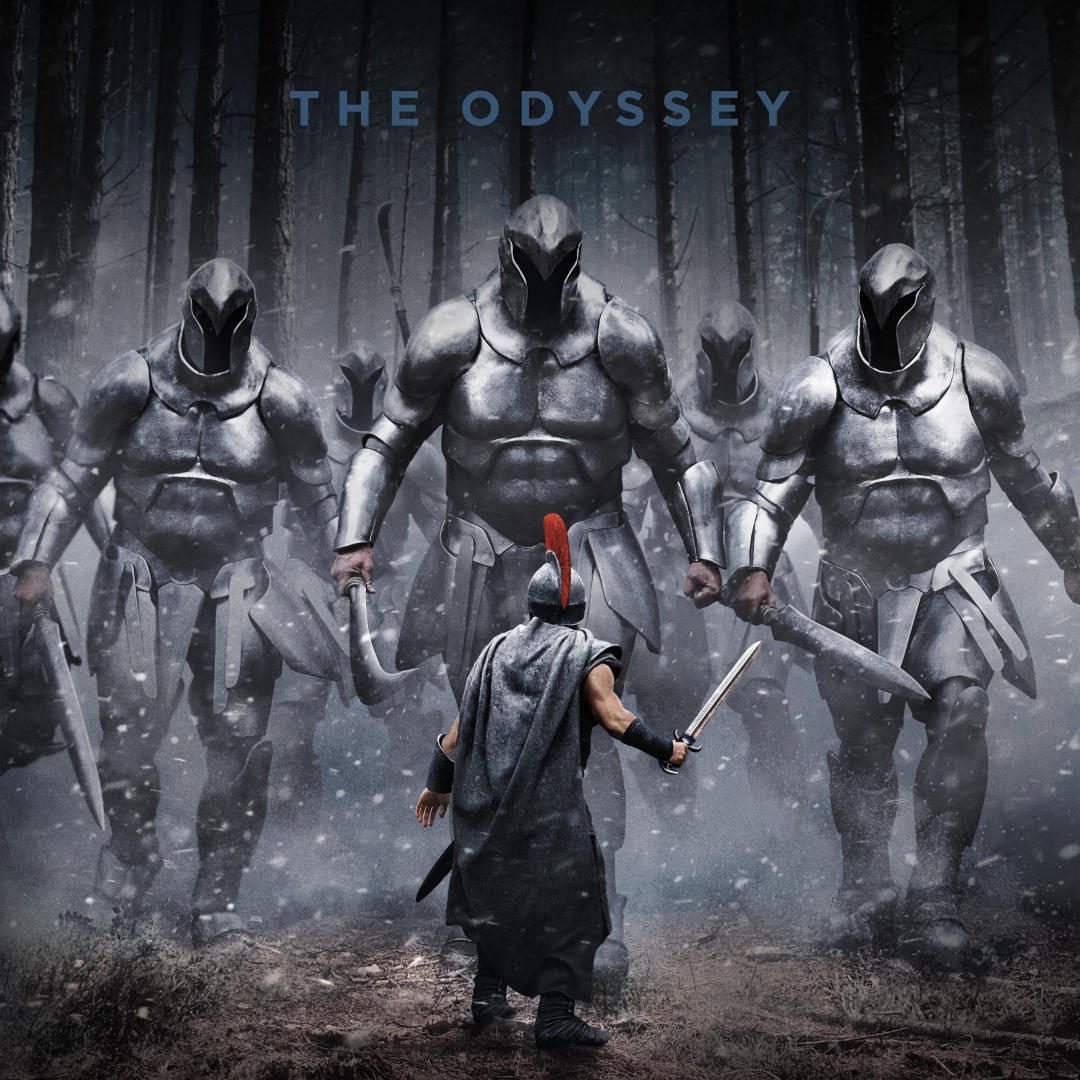
Written and directed by Christopher Nolan, THE ODYSSEY is an epic action-fantasy following the Greek king of Ithaca on a perilous, mythical journey home after the Trojan War.
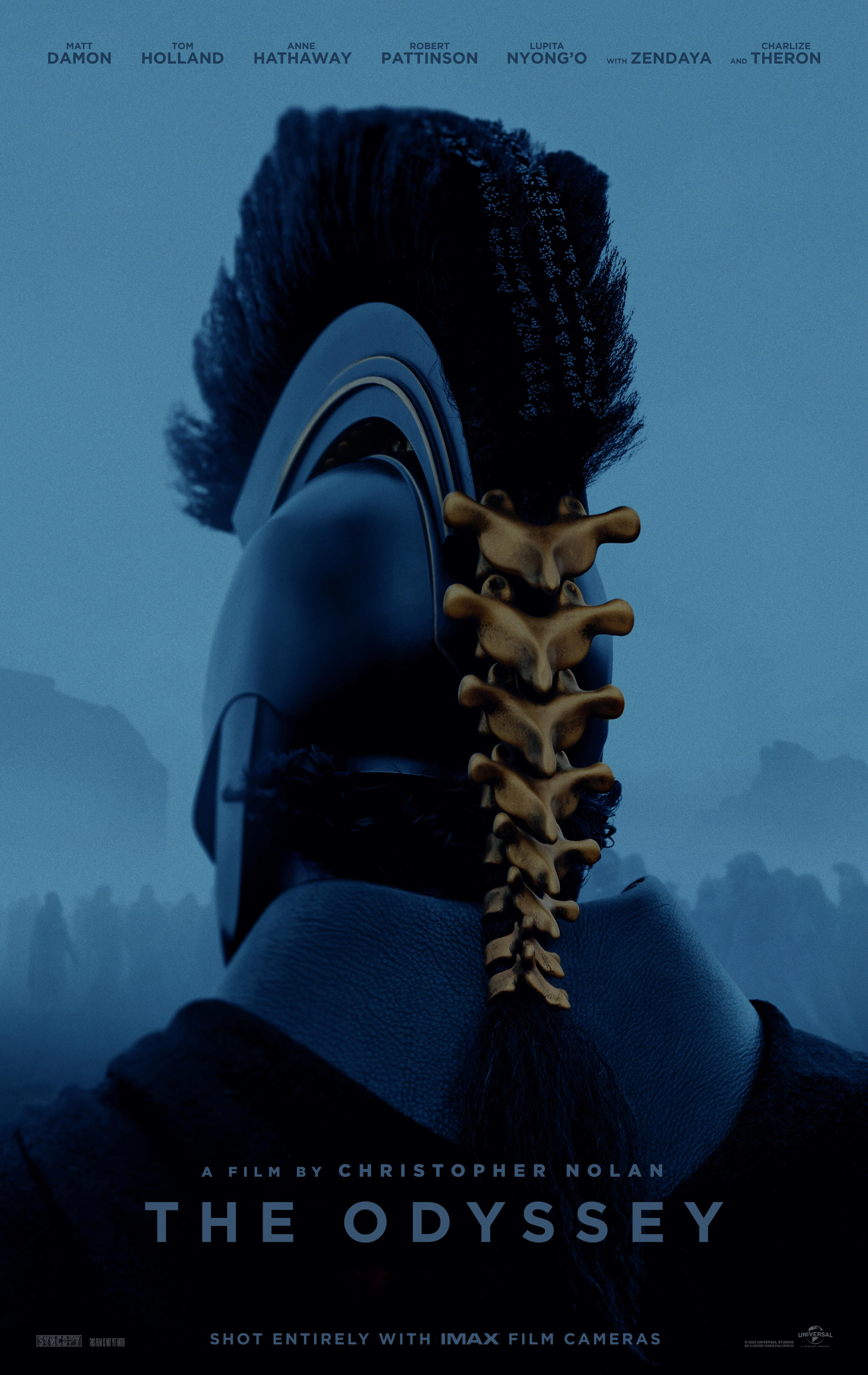
THE ODYSSEY premiered in London on 6 July 2026. The film was theatrically released in the United States and the United Kingdom on 17 July.