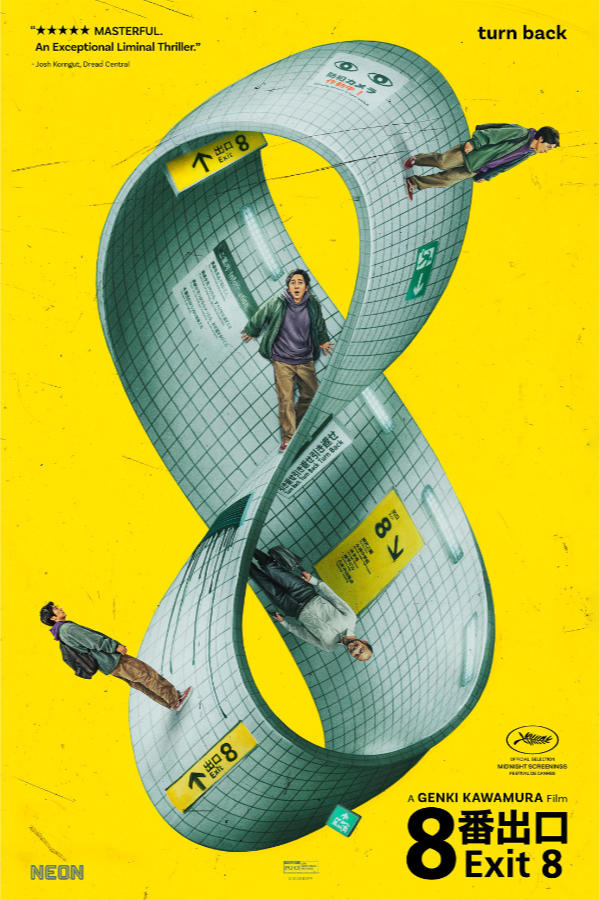
Trapped in an endless subway passageway, a man must spot the anomalies and follow the rules to escape. The rules of his quest are simple: do not overlook anything out of the ordinary. If you discover an anomaly, turn back immediately. If you don’t, carry on. Then leave from Exit 8. But even a single oversight will send him back to the beginning. A film by Genki Kawamura, starring Kazunari Ninomiya, Yamato Kochi, Naru Asanuma, Kotone Hanase, Hirota Otsuka, Tara Nakashima, Reo Soda, Mikio Ueda, Hikakin, and Nana Komatsu.
8番出口
Exit 8
Genki Kawamura
(2025)
On a crowded subway train during rush hour, a man (Kazunari Ninomiya) scrolls through his social feed, listening to Maurice Ravel’s Boléro. Distracted by the sound of a baby crying, he removes his left AirPod and turns toward the noise to see a seated woman cradling an infant in her arms.

AirPods Pro can reduce the noise of baby crying to some extent, but active noise cancellation (ANC) technology in them is not fully effective against the unpredictable and high-pitched nature of baby cries. ANC works best with consistent, low-frequency sounds like airplane engines, but struggles with sudden, sharp noises like crying.

As the baby’s cries grow louder, a businessman (Hirota Otsuka) standing in front of the woman (Tara Nakashima) becomes agitated. Suddenly, he lashes out, scolding her for being thoughtless by bringing a noisy child onto a crowded train. The man looks around and sees that although other passengers notice the commotion, they choose to ignore it and return to their phones. He turns away, puts his left AirPod back in his ear, and resumes his music.
Maurice Ravel’s Boléro is an orchestral composition first performed in Paris on 22 November 1928. It was originally written as a ballet for the dancer Ida Rubinstein. The piece is known for its unique structure built on a single repetitive melody over a steady rhythmic pattern inspired by the traditional Spanish boléro dance. The melody starts softly, introduced by the flute, and is repeatedly played by different instruments as the music gradually builds in volume and intensity over about 15 to 17 minutes, culminating in a powerful orchestral climax. The composition is notable for its gradual crescendo and brilliant use of orchestral color, where each instrument or section gets a turn to carry the melody. Despite some early critical skepticism about its repetitiveness, Boléro became Ravel’s most famous work and remains a staple of the classical music repertoire.

Suddenly, he receives a call from a woman (Nana Komatsu). Still on the subway, he declines it. Moments later, he exits the train and ascends the narrow stairs, moving with the flow of commuters. As he walks, the same woman calls again. This time, he answers. When she asks his location, he replies that he is heading to his temp job. She reveals she is at the hospital; the doctor has confirmed she is pregnant. She asks what he wants to do, pointing out that he was never clear about where they stood or if he wanted a child.
It is considered Japanese etiquette to not answer or make phone calls on the subway or any train. Talking on the phone in this public setting is seen as rude and disruptive to fellow passengers. The common practice is to switch phones to silent mode and avoid phone conversations entirely while on the train. If an important call must be taken, the proper etiquette is to get off at the next station and talk away from the crowded train. This rule is part of broader train manners to respect shared public spaces and is especially emphasized in crowded conditions and near priority seating areas where phones should often be turned off.

During the conversation, a notification banner pops up on his screen: an email reminder for a 10 AM meeting. As he weighs his thoughts, the woman tells him she has already made up her mind. He is unaware that the crowd around him has disappeared and that he is climbing the flight of stairs alone. Suddenly, the line turns to static and disconnects before he can hear her decision. He looks around, finding himself in a long corridor with a sign hanging from the ceiling that reads “出口 8” (Exit 8). He follows the sign, passing a middle-aged businessman (Yamato Kochi) walking in the opposite direction.
迷う男
The Lost Man

He keeps walking, turning left past a bank of lockers and a photo booth. He turns right, passing a large yellow sign that reads “出口 0” (Exit 0). After navigating another series of turns, he finds himself in a long corridor where the same yellow signage hangs from the ceiling: “出口 8” (Exit 0) Ahead, he spots a middle-aged businessman walking in the opposite direction. He feels confused, unsure if it’s the same man he passed earlier.

He continues through the underground passageway, only to find himself looping back to the corridor with the same yellow ‘Exit 8’ sign. However, as he passes the middle-aged man, the sound of footsteps abruptly stops. Curious, he slowly turns back. The middle-aged man is standing motionless, staring at him with an unsettling grin. Frightened, he spins around and hurries away.

After another series of turns, he arrives at the same corridor. Seeing the middle-aged man walking toward him again, panic sets in, and he turns around to retreat. This time, he spots a large yellow sign that reads “Exit 0”. He presses on, only to arrive at the exact same corridor once more.

Realizing he is trapped in an endless loop of underground passageways, he desperately attempts to find an escape. He tries twisting the doorknobs along the hall, but finds them all locked. He stops to notice a poster for a Maurits Escher exhibition, featuring the artwork Möbius Strip II. As he approaches it, red blood suddenly streams down the wall. He recoils in shock as blood begins to pour from the ceiling and the vents.

Möbius Strip II (Red Ants) is a 1963 woodcut artwork by the Dutch artist Maurits Cornelis Escher. The piece features a Möbius strip adorned with numerous large, detailed red ants crawling endlessly along the strip. This creates a surreal visual of ants traversing a never-ending loop, symbolizing infinity and the cyclical nature of existence. The ants move seamlessly on both sides of the strip without crossing an edge, illustrating the unique one-sided property of the Möbius strip.

Terrified, he sprints back the way he came, where he finds the middle-aged man standing motionless, eyes fixated on his phone. Glancing at the wall, he notices that the number on the large yellow sign has changed from 0 to 1. Next to the large sign, there’s a smaller placard with instructions printed on it.

The man finally realizes that he must follow the instructions to find Exit 8 and escape. As he loops back to the corridor, he begins scouring the area for anything out of the ordinary. He attempts to ask the middle-aged man about Exit 8, but the stranger ignores him, continuing to walk like an NPC in a game.

As he continues through the passageway, he doesn’t see anything unusual. However, he is unaware that the pattern of the fluorescent lights on the ceiling has shifted. Having failed to spot the anomaly, he arrives at the large sign only to see that the number 1 has changed to 0. He has to start over.




Escape is an anomaly.
—
A film by Genki Kawamura, starring Kazunari Ninomiya, Yamato Kochi, Naru Asanuma, Kotone Hanase, Hirota Otsuka, Tara Nakashima, Reo Soda, Mikio Ueda, Hikakin, and Nana Komatsu.
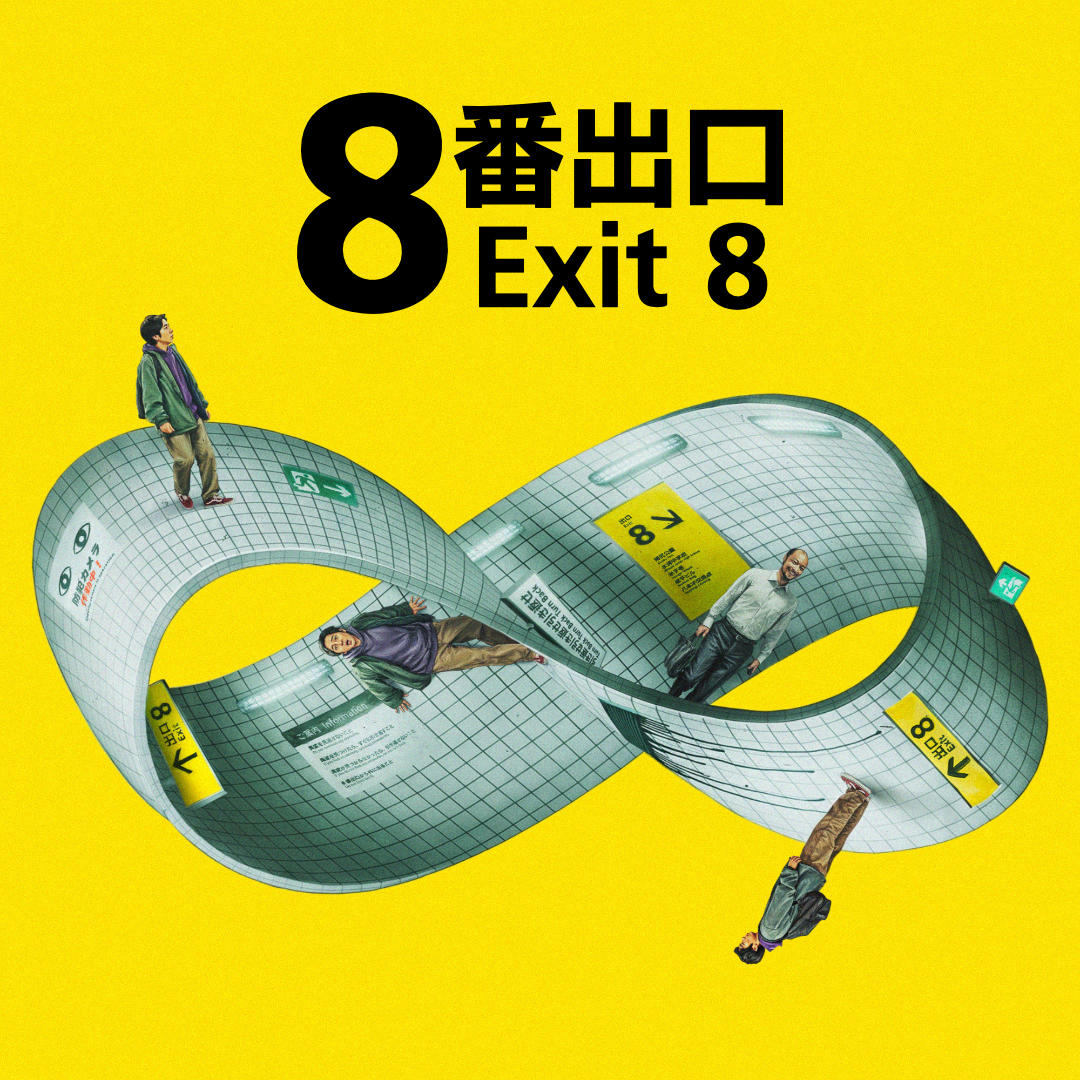
Directed by Japanese filmmaker Genki Kawamura, Exit 8 is a mystery psychological thriller adapted from the adventure game 8番出口 (The Exit 8), with a screenplay co-written by Kawamura and Kentaro Hirase.

The Exit 8 is a 2023 adventure walking simulator game developed by KOTAKE CREATE. The game is set in a Japanese metro station’s underground passageway, where the player must walk through a corridor and spot anomalies (subtle inaccuracies in the environment’s layout) to progress. It is inspired by liminal spaces and the surreal atmosphere of underground passageways, with a psychological horror element. Gameplay involves the player observing the passageway surroundings carefully; if they spot anomalies, they turn back to the previous exit, and if they find none, they proceed forward. The player must correctly identify anomalies eight times in a row to reach Exit 8 and escape. A wrong assessment resets progress to the start. By August 2024, The Exit 8 had reached over 1 million downloads, and by January 2025, it crossed 1.4 million downloads worldwide. As of August 2025, total sales surpassed 2 million copies worldwide.

Exit 8 is captivating from start to finish, sustaining its tension almost without missing a beat. The rules of the environment are deceptively simple: we follow the protagonist as he ventures through a seemingly endless subway passageway. No matter which direction he chooses, he always returns to the same corridor, yet each iteration contains subtle, unnerving anomalies. The cinematography is mesmerizing, keeping the viewer on edge as our eyes constantly scan the scene, hoping to spot a deviation before the protagonist does.

However, the film isn’t without flaws. There’s a scene that clearly pays homage to the iconic moment in The Shining (a river of blood gushing from an elevator door and flooding a hallway), but the CGI isn’t convincing enough. It might be passable in a game, but it falls short on screen. Nevertheless, Exit 8 remains one of the most effective and well-executed game-based movies I have ever seen.

8番出口 (Exit 8) premiered at Festival de Cannes on 19 May 2025. The film was theatrically released in Japan on 29 August.

Exit 8 (2025)
8番出口