
Scientists have discovered how to “hop” human consciousness into lifelike robotic animals, allowing people to communicate with animals. A college student seizes an opportunity to use the technology, uncovering mysteries within the animal world that are beyond anything she could have imagined. A film by Daniel Chong, featuring the voices of Piper Curda, Bobby Moynihan, Jon Hamm, Kathy Najimy, Dave Franco, Eduardo Franco, Aparna Nancherla, Tom Law, Sam Richardson, Melissa Villaseñor, Isiah Whitlock Jr., Steve Purcell, Ego Nwodim, Nichole Sakura, Karen Huie, Vanessa Bayer, and Meryl Streep.
HOPPERS
Daniel Chong
(2026)
In the city of Beaverton, young Mabel Tanaka (Lila Liu) has never quite fit in. Even in kindergarten, her social awkwardness and constant urge to free the class pets keep getting her into trouble. Whenever the teachers catch her, Mabel struggles to control her temper. After lashing out and biting an instructor, she gets suspended, forcing her mother (Lori Alan) to scramble and drop her off at her grandmother’s house before rushing back to work.
Grandma Tanaka (Karen Huie) seems to understand exactly what Mabel is going through, as if she sees her younger self in the little girl. Calmly, she leads Mabel to a nearby forest glade and takes a seat on a large rock by the pond, waiting for her granddaughter to join her. Still simmering with anger and feeling like nobody in the world understands her, Mabel reluctantly sits beside her. Grandma Tanaka tells her that she too used to be angry all the time when she was young, but that she isn’t anymore. She teases that if Mabel wants to know her secret, she’ll show her, and gestures toward the pond. Intrigued, Mabel squints and scans the water, but seeing nothing. She quickly loses patience, assuming her grandmother is toying with her. Leaning in close, Grandma Tanaka whispers that Mabel just has to be perfectly still, watch, and listen.
Then the wind picks up, soft and gentle, sending ripples across the surface of the pond. Tadpoles drift into the shallows. Dragonflies skim the water. Fish break the surface, frogs leap from the banks, and a family of ducklings bobs along behind their mother. A doe emerges from the tree line, followed by two fawns. Spiders spin in the reeds, a flock of bluebirds sweeps overhead, and a family of beavers wades along. Mabel watches in awe as the glade comes alive around her.
Sensing the anger drain from her granddaughter, Grandma Tanaka smiles. “That’s what nature does,” she says softly. “It’s hard to be mad when you feel like you’re a part of something big.” From that moment on, Mabel has found her place in the world. She visits her grandmother every day just to sit in the glade, observe the wild animals, and learn how to live alongside them.
Deeply inspired by the woman who taught her to appreciate nature, Mabel grows up with a profound connection to the forest. After Grandma Tanaka passes away, Mabel continues to watch over the glade, honoring the sanctuary that brought her peace.
In the present day, Mabel (Piper Curda) is a college student who has repeatedly clashed with Beaverton’s mayor, Jerry Generazzo (Jon Hamm), through a string of protests against his plan to demolish the glade and complete the Beaverton Beltway. When she confronts him over the wildlife that would be displaced, Jerry dismisses her, insisting that no animals live there anymore. To her dismay, Mabel begins to realize he may be right. The wild animals that once filled the glade with life have mysteriously vanished.
Knowing he has the upper hand, Jerry offers Mabel a deal: if she can gather enough signatures from the citizens of Beaverton, he will hear her out. But the clock is ticking. She has just 48 hours before his construction crews begin pouring concrete into the pond. However, gathering signatures proves far harder than Mabel anticipated. Door after door closes in her face, and no one in Beaverton seems the least bit interested in saving the glade.
Just as hope begins to slip away, she comes across Jerry’s presentation online, in which he mentions that the state only granted him permission to build on the condition that the land had no wildlife. Mabel realizes that if she can prove the glade is still inhabited, she can stop the project in its tracks.
The next day, Mabel bursts into Dr. Samantha “Sam” Fairfax’s lecture at Beaverton University, desperate for her help. But Dr. Sam is less concerned about the glade than she is about Mabel herself, pointing out that she is failing her class, constantly getting herself hurt, and letting her obsession consume her life. When Mabel presses her, Dr. Sam sides with the mayor, explaining that the animals are simply gone. Once the resident beaver abandoned the pond, the rest followed. She tells Mabel plainly that she can’t save that place on her own. Only a beaver can.
Surprised, Mabel asks how. Dr. Sam explains that beavers are a keystone species. It only takes one to dam a stream and maintain it, and before long, the pond comes back to life and the animals return with it. Energized by the idea that a beaver could save the glade, Mabel rushes off to find one.
Back at the glade, Mabel sets up a trap and does her best to lure a beaver in, but nothing goes as planned. She waits patiently as the hours drag on and night falls. Just as her hopes begin to fade again, a beaver emerges from the tree line and approaches her decoys. But rather than taking the bait, it squeezes through a gap in the fence and crosses the road. Mabel races after it, arriving just in time to see a vehicle bearing down on the beaver. She braces for the worst, but the black van screeches to a halt beside it. The door flies open, someone reaches out and snatches the beaver inside, and the van speeds off into the night.
Convinced the beaver has been abducted, Mabel races after the van on her skateboard, determined to rescue it, only to find the van heading straight back to Beaverton University. She watches from a distance as it pulls around to the back of a building, where the beaver is let out and disappears through a small gap in a roller shutter. Mabel slips in after it and follows it deeper into the building, where she stumbles upon something she never expected: Dr. Sam’s secret lab.
Jumping to conclusions, Mabel assumes Dr. Sam is experimenting on real animals and immediately becomes furious. Dr. Sam’s colleague, Nisha (Aparna Nancherla), quickly intervenes to explain that what Mabel is witnessing aren’t actual animals, but incredibly lifelike robotic replicas built to observe wildlife up close. Dr. Sam calls the technology “Hoppers.” Using a proprietary mind-casting apparatus, the scientists can “hop” into the robots, effectively transferring their consciousness into the mechanical animals to study and communicate with the natural world without interference.
Realizing the Hopper technology is essentially like James Cameron’s AVATAR, Mabel proposes a bold plan. She suggests that Dr. Sam could save the glade by finding a beaver and convincing it to return home. However, Dr. Sam and Nisha firmly refuse, insisting their strict policy is to observe, never to interfere with nature. Determined to save the glade with or without their help, Mabel goes rogue. She uses the machine to transfer her own consciousness into a robotic beaver and flees the lab, venturing out into the forest to track one down herself.


We're all in this together.
—
A film by Daniel Chong, featuring the voices of Piper Curda, Bobby Moynihan, Jon Hamm, Kathy Najimy, Dave Franco, Eduardo Franco, Aparna Nancherla, Tom Law, Sam Richardson, Melissa Villaseñor, Isiah Whitlock Jr., Steve Purcell, Ego Nwodim, Nichole Sakura, Karen Huie, Vanessa Bayer, and Meryl Streep.
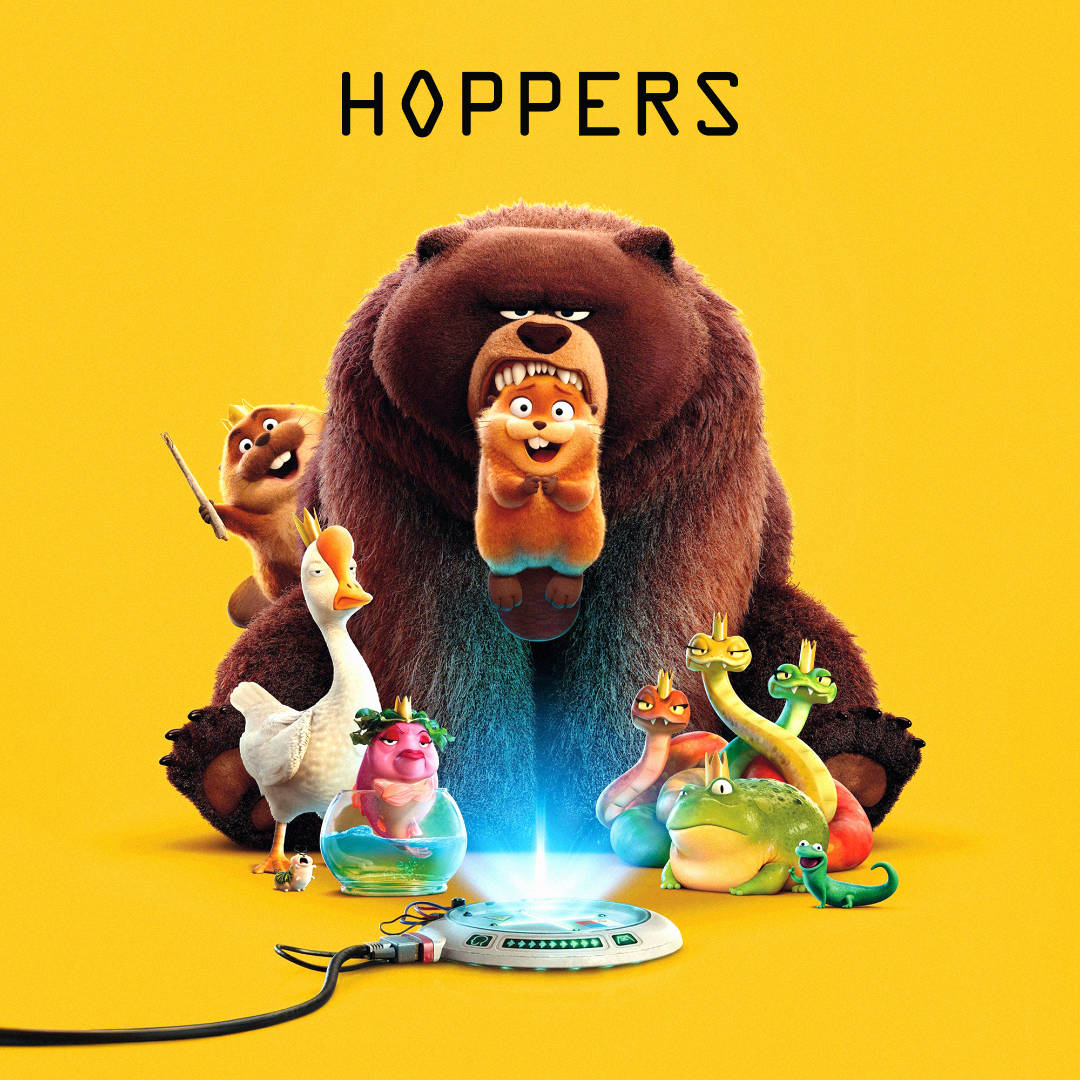
Directed by American animator Daniel Chong from a screenplay by Jesse Andrews, based on an original story by Chong and Andrews, Hoppers is an animated science fiction film following a college student who goes undercover by transferring her consciousness into a lifelike robotic beaver. Her mission is to find and persuade a real beaver to return to a forest glade, hoping other animals will follow. She believes repopulating the woods is the only way to stop a greedy mayor from paving it over for a new freeway, all to secure his reelection.
Entertaining and delightfully self-aware, the film isn’t afraid to lean into its own absurdity. It features hilarious dialogue where the characters insist their mission is absolutely nothing like Avatar, despite the obvious similarities.
Among the film’s most memorable sequences is the majestic entrance of the Animal High Council, a gathering of the natural world’s ruling monarchs: Amphibian King (Steve Purcell), a regal frog; Bird King (Isiah Whitlock Jr.), a imperious goose; Fish Queen (Ego Nwodim); the Reptile Queens, a trio of snake sisters (Nichole Sakura); and presiding over them all, Insect Queen (Meryl Streep), an all-powerful butterfly.
It’s difficult not to draw comparisons to Avatar since they share such a similar concept. Rather than merging human and target DNA to grow an organic body or constructing an entirely new language as James Cameron’s film famously did, HOPPERS opts for the quick and easy solution of building lifelike animal robots. And that is perfectly fine, because this is a lighthearted comedy cartoon, not a sci-fi epic striving for believable world building. Still, the plot suffers from the exact same logic flaw seen in The Wild Robot. In both films, the robots miraculously can communicate universally with various animals, despite the fact that different species naturally communicate in completely different ways.
It’s also quite annoying how the movie keeps shoving multiple flashbacks of Mabel’s grandmother in our faces just to repeat her quote: “It’s hard to be mad when you feel like you’re a part of something big.” It is a lovely sentiment the first time, but Hoppers returns to it twice it begins to feel less like emotional resonance and more like the filmmakers don’t trust their audience to remember something they heard barely an hour ago. A little faith in the viewer goes a long way.
Another scene that doesn’t quite sit right is the moment Mabel accidentally kills Insect Queen. It’s not entirely unexpected as a plot device, and it does serve as a pivotal turning point, but the film’s handling of it exposes an uncomfortable double standard. For a story that takes the sanctity of animal life very seriously, HOPPERS seems remarkably unbothered by the fact that a human just squashed an insect, even an insect of apparent royal standing. Yet the moment an animal turns on a human, the film suddenly draws the moral line. It is a contradiction the film never acknowledges, and the more you think about it, the harder it is to shake.
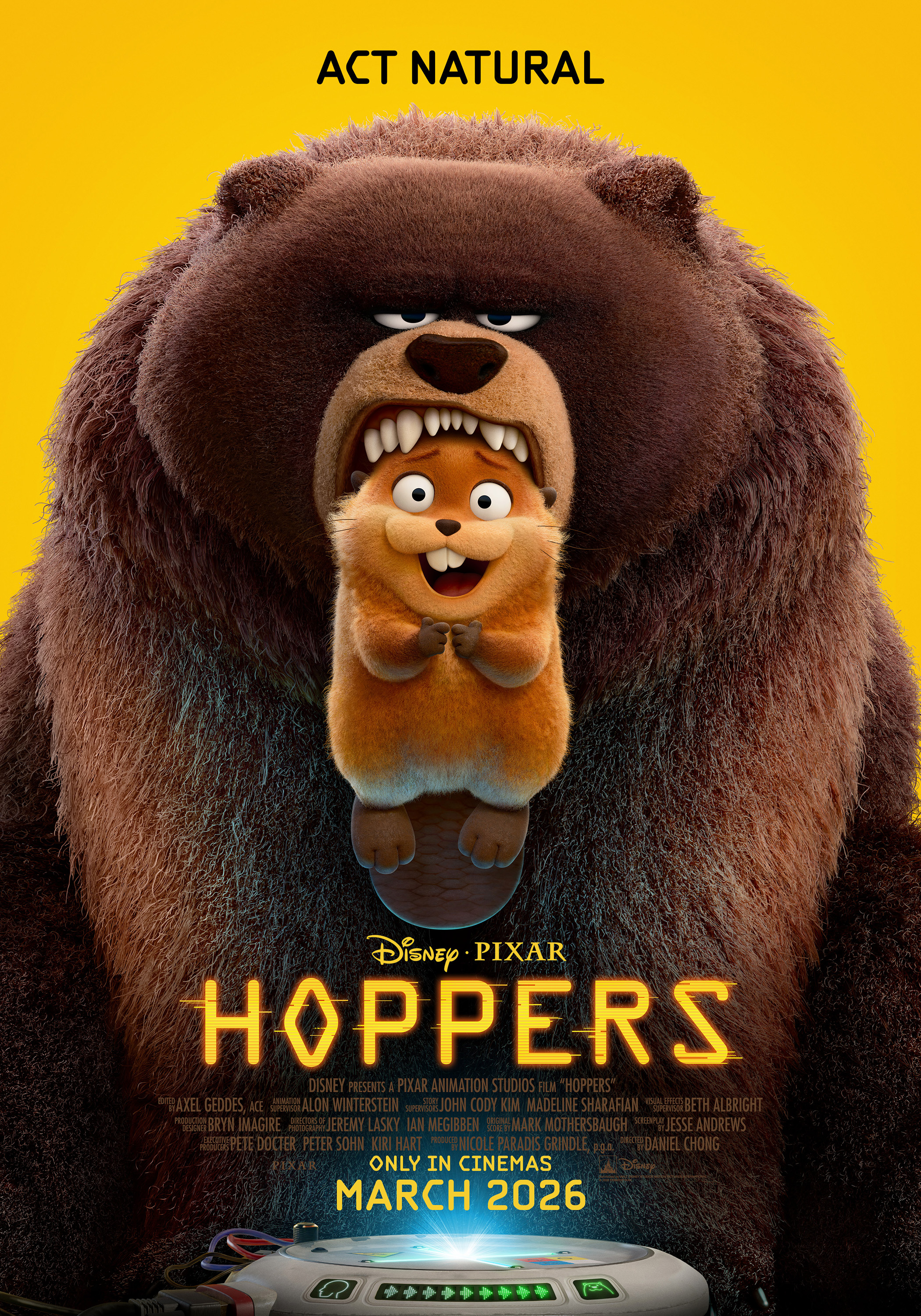
HOPPERS premiered at the El Capitan Theatre in Los Angeles on 23 February 2026. The film was theatrically released in the United States on 6 March.

HOPPERS (2026)
We're all in this together.