A wealthy industrialist becomes a victim of extortion when his chauffeur’s son is kidnapped by mistake and held for ransom. A film by Akira Kurosawa, starring Toshiro Mifune, Tatsuya Nakadai, Kyoko Kagawa, Tatsuya Mihashi, Yutaka Sada, and Tsutomu Yamazaki.
天国と地獄
HIGH and LOW
Akira Kurosawa
(1963)
Three National Shoes directors visit factory executive director Kingo Gondo (Toshiro Mifune) to discuss the company’s future: Design Director Ishimaru (Nobuo Nakamura), Publicity Director Kamiya (Jun Tazaki), and Sales & Operations Director Baba (Yunosuke Ito).

They’re all frustrated with their aging president, who owns the largest share of stock and uses his influence at shareholder meetings to keep producing what they see as outdated, old-fashioned shoes built to last. The directors argue this approach is killing their business because if shoes never wear out, customers won’t buy new ones.

Ishimaru shows Gondo a sleek new shoe design that’s both stylish and costs less than half their current model to manufacture. But Gondo doubts the president would ever approve such a departure from their traditional approach. That’s when Baba reveals their real plan: a corporate takeover. The three directors currently control only 21% of the company’s stock, but if Gondo joins them with his 13% stake, they’ll have 34% of the shares, which will be more than enough to force out the president. When Gondo asks who will take over as the new president, Kamiya explains that since it’s Baba’s idea, Baba will step into the role.

Gondo steps onto his balcony to examine Ishimaru’s shoe while weighing the directors’ proposal. After a moment, he admits that while the president may be old-fashioned, at least he produces reak shoes. Gondo holds up the sample and declares it’s so flimsy it wouldn’t last a month, calling it worthless junk that would damage their reputation. He takes pride in his craftsmanship and rejects their offer outright. Gondo explains that he believes in making shoes that are comfortable, durable, and attractive. While such shoes cost more to produce, they generate lasting profits. Baba threatens that if Gondo won’t join them, they’ll align with the president to force Gondo out instead. Angered by the threat, Gondo asks them all to leave.

Later, Gondo gets a phone call that clearly delights him. Afterward, he tells his wife Reiko (Kyoko Kagawa) and secretary Kawanishi (Tatsuya Mihashi) that he’s been quietly planning to take over the company himself, and now everything is ready. Over the past three years, he’s secretly bought another 15% of the company. The phone call confirmed he’s just acquired another 19%, bringing his total to 47% of the shares. Reiko becomes concerned and wonders where he got so much money. Gondo admits he’s borrowed against everything they have, including the house. Now he just needs to send Kawanishi to Osaka with 50 million yen to close the deal.

As Gondo instructs his chauffeur Aoki (Yutaka Sada) to take Kawanishi to the airport for the 10:00 flight, he gets another phone call from an unknown caller. Gondo is stunned when the caller says he’s kidnapped Gondo’s son and demands 30 million yen to return the boy alive. The kidnapper specifies that the bills cannot have consecutive serial numbers and must consist of one thousand 10,000-yen notes, three thousand 5,000-yen notes, and five thousand 1,000-yen notes. He orders Gondo to prepare the money by tomorrow, saying he’ll call back with further instructions. Before ending the call, the kidnapper warns Gondo not to contact the police if he wants his son to live.

Moments later, Gondo’s son Jun appears, and everyone feels relieved to see him safe. At first, Gondo thinks the phone call was just a prank, but then he realizes that the kidnapper must have taken Aoki’s son Shinichi by mistake. Gondo decides to contact the police, figuring that once the kidnapper learns he grabbed the wrong boy, he’ll let Shinichi go since Aoki has no way to pay such a large ransom.

When Inspector Tokura (Tatsuya Nakadai) and his team arrive at Gondo’s house disguised as department store delivery workers, he explains that kidnapping cases are complicated and not as simple as Gondo assumes. Even if they announce on radio and TV that the kidnapper grabbed the wrong child, he might still think the boy is Gondo’s son and kill him out of anger for contacting the police. The police’s top priority is rescuing the boy first, then apprehending the kidnapper.

The kidnapper calls back, admitting he’s taken the wrong boy but saying he doesn’t care. He demands that Gondo pay the 30 million yen ransom or the child will die. Even though Gondo keeps insisting he won’t pay, the kidnapper is certain that Gondo will give in because he doesn’t have the gut to let an innocent boy be killed.

Gondo suspects the kidnapper isn’t just after money but wants to humiliate him as well. Reiko begs Gondo to pay the ransom, feeling guilty because Shinichi was kidnapped instead of Jun. When Kawanishi questions whether Inspector Tokura can promise the boy’s safety if Gondo pays, noting that the child could already be dead or murdered later, Inspector Tokura says they can only hope that the kidnapper will honor his agreement. However, he warns there’s also a risk the kidnapper could kill the boy if Gondo refuses to pay.

Gondo faces an agonizing choice between the money and the boy’s life. Kawanishi reminds him that paying the ransom would destroy everything they’ve worked for. Just as Gondo tells Kawanishi to proceed to Osaka and finalize the deal, the kidnapper calls back. This time, he puts Shinichi on the phone, allowing Gondo to hear the boy’s voice and confirm he’s alive. The kidnapper presses Gondo to decide carefully, emphasizing that the child’s fate rests in his hands. After the kidnapper hangs up, Aoki pleads with Gondo to save Shinichi, admitting that he hadn’t been able to ask Gondo to pay so much money because he didn’t know whether his son was even still alive.

The next morning, Gondo announces he has made his decision that he won’t pay the ransom because he refuses to sacrifice everything for the boy. When he tells Kawanishi to deliver the check to Osaka and finalize the deal, Kawanishi becomes upset and protests. He warns that if Gondo takes over the company now, his reputation will be destroyed when people learn he let a child die. Gondo grows suspicious of this sudden shift in Kawanishi’s attitude and realizes his secretary has turned against him, siding with the three directors. After Kawanishi storms out, Inspector Tokura asks Gondo to pretend he’ll pay the ransom to extract information about the exchange location. When the kidnapper calls, Gondo plays along as instructed. He also insists on seeing the boy alive before the exchange.

Directed by Japanese filmmaker Akira Kurosawa from a screenplay he co-wrote with Hideo Oguni, Eijiro Hisaita, and Ryuzo Kikushima, HIGH and LOW (天国と地獄) is a crime thriller film following a Japanese businessman who is forced to make a difficult choice when his chauffeur’s son is mistakenly kidnapped instead of his own son. The story is loosely based on Ed McBain’s 1959 novel King’s Ransom.
The novel King’s Ransom by Evan Hunter (published under the pen name Ed McBain) revolves around Douglas King, a wealthy and ambitious executive trying to gain control of the Granger Shoe Company through a major corporate deal. His plans are suddenly complicated when kidnappers mistakenly abduct the son of his chauffeur instead of King’s own son and demand a $500,000 ransom. King faces a harsh moral dilemma: whether to pay the ransom and save the child’s life, which would financially ruin his business deal, or refuse to pay and prioritize his personal ambitions.

The story is engaging throughout, even with its large cast of supporting characters. The actors deliver compelling performances making everything feel authentic, particularly Toshiro Mifune and Tatsuya Nakadai.

The cinematography is exceptional, featuring carefully composed shots in every scene. This is especially evident in the scenes inside Gondo’s house, where the actor positioning and movement are so sharp and deliberate, creating an almost stage play quality that enhances the drama.

I like how they don’t show the kidnapper’s face in the first half of the film. This keeps his identity elusive and ambiguous, making you constantly guess who’s the mastermind behind the kidnapping. Is it part of a plan by the three directors to sabotage Gondo, especially since it happened right after they left, which seems way too convenient to be a coincidence? Or is it someone else entirely?

HIGH and LOW stands as one of the finest police procedural films ever made, perfectly showing how investigators work against the clock to save the boy and capture the kidnapper. I’m amazed by how the film manages to maintain constant tension during investigation scenes that could easily feel mundane, but instead turn out to be thrilling and riveting as the story unfolds.

天国と地獄 (HIGH and LOW) was theatrically released in Japan on 1 March 1963.

The 4K Ultra HD edition of 天国と地獄 was released in Japan on 17 May 2023. The disc features a remastered black and white 2160p presentation, original Japanese 4-channel Linear PCM audio, and Japanese subtitles. Special features include theatrical trailers and a stills gallery.

The Criterion Collection’s 4K Ultra HD edition of Akira Kurosawa’s HIGH and LOW was released on 9 September 2025. This edition features a new 4K digital restoration with a 4.0 surround DTS-HD Master Audio soundtrack and includes one 4K UHD disc of the film alongside a Blu-ray disc containing the film and special features. Supplements include an audio commentary featuring Kurosawa scholar Stephen Prince, the documentary on the making of HIGH and LOW, created as part of the Toho Masterworks series Akira Kurosawa: It Is Wonderful to Create, interviews with actors Toshiro Mifune and Tsutomu Yamazaki, theatrical trailers and teasers, an essay by critic Geoffrey O’Brien and an on-set account by Japanese-film scholar Donald Richie.
A film by Akira Kurosawa (黒澤明), Starring Toshiro Mifune (三船敏郎), Tatsuya Nakadai (仲代達矢), Kyoko Kagawa (香川京子), Tatsuya Mihashi (三橋達也), Isao Kimura (木村功), Kenjiro Ishiyama (石山健二郎), Takeshi Kato (加藤武), Takashi Shimura (志村喬), Jun Tazaki (田崎潤), Nobuo Nakamura (中村伸郎), Yunosuke Ito (伊藤雄之助), Tsutomu Yamazaki (山崎努), Minoru Chiaki (千秋実), Eijiro Tono (東野英治郎), Yutaka Sada (佐田豊), Masahiko Shimazu (島津雅彦), Toshio Egi (江木俊夫), Koji Mitsui (三井弘次), Kyu Sazanka (山茶花究), Susumu Fujita (藤田進), Kamatari Fujiwara (藤原釜足), Yoshio Tsuchiya (土屋嘉男), Kazuo Kitamura (北村和夫), Gen Shimizu (清水元), Akira Nagoya (名古屋章), Jun Hamamura (浜村純), Masao Oda (織田政雄), Ko Nishimura (西村晃), Yoshifumi Tajima (田島義文), Koji Kiyomura (清村耕次), Hiroshi Unayama (宇南山宏), Yoshisuke Makino (牧野義介), Jun Kondo (近藤準), Satoshi Suzuki (鈴木智), Senkichi Omura (大村千吉), Kazuo Kato (加藤和夫), Ikio Sawamura (沢村いき雄), Kin Sugai (菅井きん), Keiko Tomita (富田恵子), Isao Onoda (小野田功), Seiichi Taguchi (田口精一), Takeo Matsushita (松下猛夫), Kiyoshi Yamamoto (山本清), Kenji Kodama (児玉謙二), Minoru Ito (伊藤実), and Haruo Suzuki (鈴木治夫).
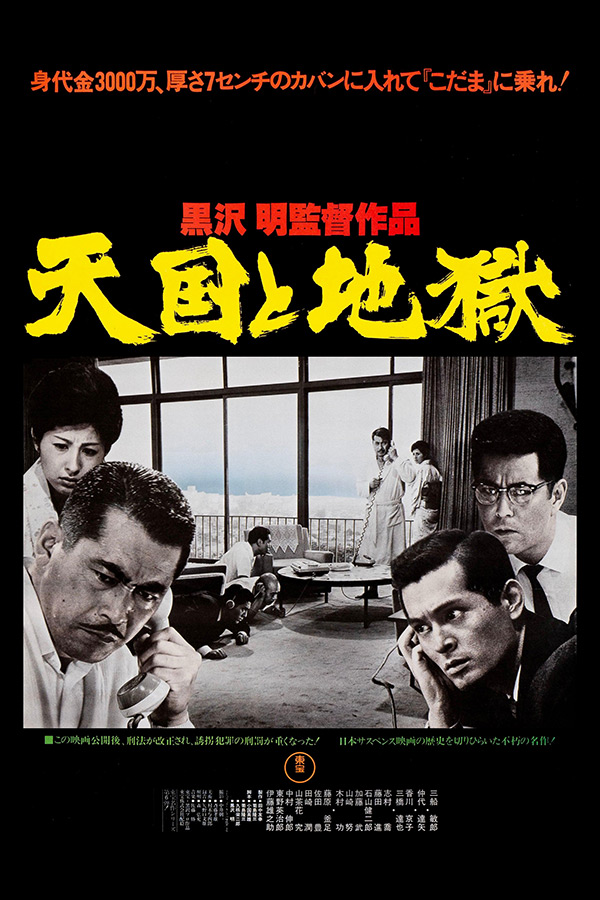
HIGH and LOW (1963)
A film by Akira Kurosawa