A nightclub pianist hitchhikes cross-country to marry his sweetheart. When one of his drivers mysteriously dies, he evades the law by adopting the dead man’s identity, leading himself down a more dangerous road. A film by Edgar G. Ulmer, starring Tom Neal, Ann Savage, Claudia Drake, Edmund MacDonald, Tim Ryan, Esther Howard, and Pat Gleason.
DETOUR
Edgar G. Ulmer
(1945)
Al Roberts (Tom Neal) arrives at a roadside diner in Reno after catching a ride. While sitting inside, a truck driver Joe (Pat Gleason) notices him and asks where he’s headed.

Al gives him a curt reply: “East.” Joe looks disappointed and mentions that if Al were going north, he could’ve given him a lift because he doesn’t like driving alone at night. When Joe asks where he’s coming from, Al answers just as tersely: “West.” It’s clear Al’s irritated and wants to be left alone.
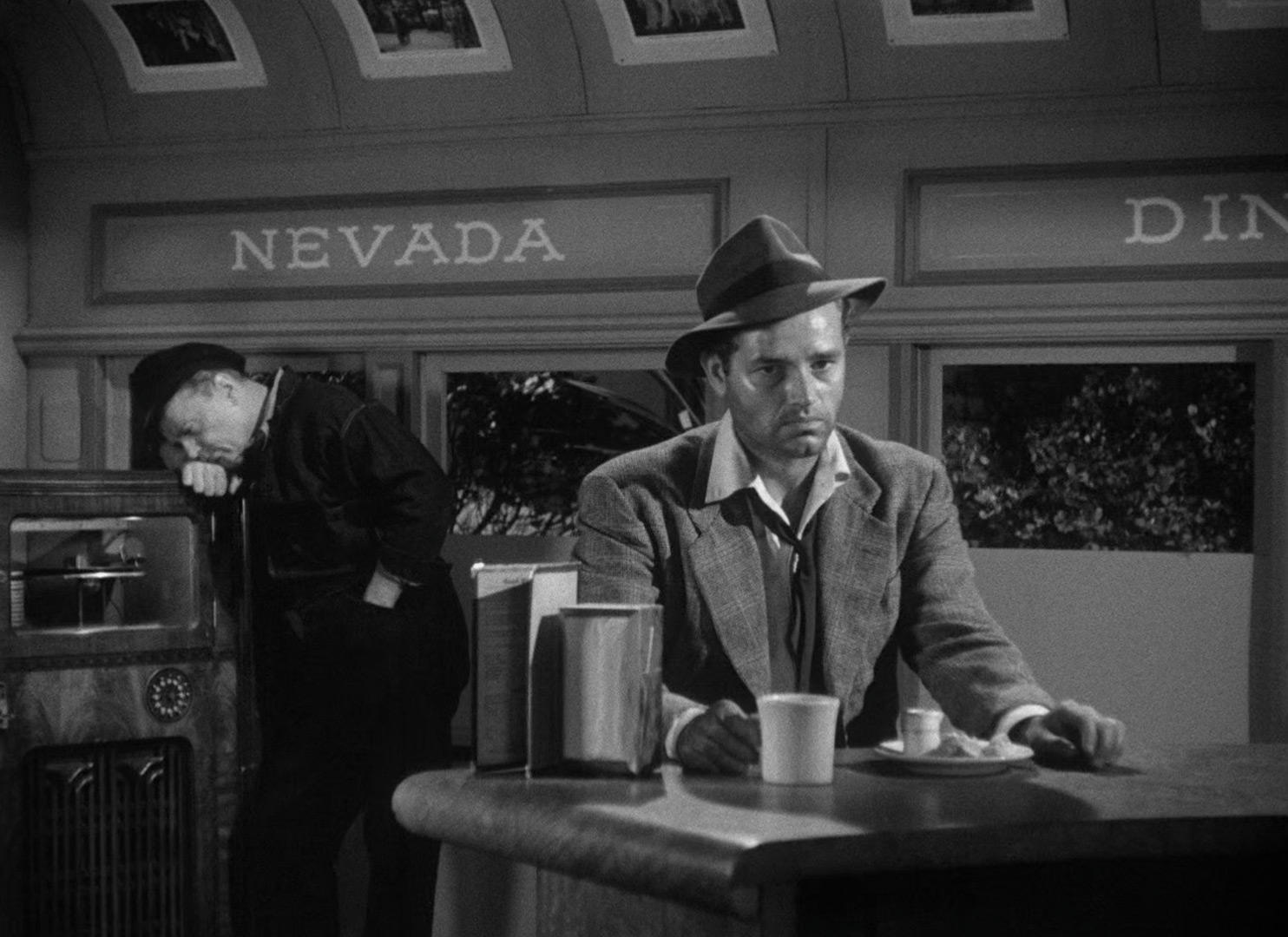
Joe asks the diner waitress Holly (Esther Howard) for some change. When she brings back the coins, she tells him to pick something quieter this time because she has a splitting headache. Moments later, a song starts playing on the jukebox, and Al becomes visibly disturbed. He loses his temper and snaps at Joe, demanding he shut it off.

Startled, Joe asks what’s wrong with him, pointing out that it’s his dime and this is a free country, so he can play whatever he wants. The diner owner (Tim Ryan) steps in and tells Al that if he doesn’t like the music, he can to leave. He dismisses Al as someone with no taste in music.
Al slowly sinks into his thoughts, haunted by the tune that seems to follow him everywhere. He used to love that song, but now he can’t stand it. The melody pulls him back to his former days, when he played piano at the Break O’ Dawn Club in New York.

Back then, Al is a struggling piano player at a nightclub, performing alongside his girlfriend Sue Harvey (Claudia Drake), the lead singer. One night after their shift, Sue tells him she can’t live like this anymore. When Al suggests they get married as planned, Sue hesitates. She says she loves him and wants to marry him, but only when they have enough money and a better life. She then confesses that she’s decided to leave and try her luck in Hollywood.

After Sue leaves, Al stays on as the nightclub pianist, though he’s clearly miserable. One night, his jazzy rendition impresses the crowd, and a guest who’s requested the song sends him a ten-dollar tip through the waiter. Later, Al calls Sue and learns she’s working as a hash slinger. He tells her to be patient and keep making the rounds at casting offices. Then he says he’ll come out to her so they can get married. Sue agrees.

Without money for a bus or train, he’s forced to hitchhike west. Along the way, he catches a ride with Charles Haskell Jr. (Edmund MacDonald) Thumbing rides may save bus fare, but it’s dangerous. Al doesn’t yet realize his life will change forever the moment he climbs into Haskell’s car. At first, neither of them speaks. Al never knows what to say to strangers, and it’s hard to tell if someone wants conversation or silence. Eventually, Haskell breaks the quiet, asking Al to grab a small box from the glove compartment and take the wheel while he swallows a pill. Al visibly relaxes when Haskell mentions he’s heading to LA too. Haskell asks if Al knows how to drive. Al says he does and offers to split the driving if Haskell needs a break.

An hour later, Al notices deep scratches on Haskell’s right hand. When Haskell catches him staring, he explains that a woman he’d given a ride to earlier did it. Haskell says she must have thought he was some kind of easy mark, but he saw right through her. He mentions he’s been booking horses at racetracks since he was 20, implying he knows a con when he sees one. Then Haskell rolls up his sleeve and shows Al a long scar running down his right arm. He says he got it dueling as a kid. One day he and another boy took down his father’s Franco-Prussian sabers and fought when his dad wasn’t home. The other kid slashed his arm, and Haskell claims he put the kid’s eye out in return. He got scared and ran away, and he’s never been back home since.

Later, Haskell pulls into a roadside diner. Though Al is hungry, he wants to save money, so he tells Haskell he’ll wait outside while Haskell eats. But Haskell waves him off and says not to worry about the money because he’s paying. Al hesitates. Haskell insists on treating him, joking that when Al makes his first million, maybe he can return the favor. Haskell mentions he has to reach the West Coast by Wednesday.

After the diner, Al takes the wheel and drives through the night while Haskell sleeps soundly in the passenger seat. Rain starts to fall. Al tries waking Haskell, thinking they should pull over and raise the convertible top, but Haskell doesn’t respond. As the rain intensifies, Al pulls to the side of the road and tries putting up the top himself. It won’t budge. He shakes Haskell again. Nothing. When Al opens the passenger door, Haskell’s body tumbles out of the car, his head striking a rock on the ground. Panicked, Al lifts him up and checks for signs of life. Haskell is dead. Staring at the gash on Haskell’s head, Al knows nobody will believe what happened. They’ll think he bashed Haskell’s skull in with that rock.

His instinct tells him to run, but then he realizes too many people have seen him with Haskell. The man at the gas station and the waitress at the diner must remember their faces. If the police question him, it’ll look like he killed Haskell and fled. But waiting for the cops doesn’t seem like a better option either. They won’t believe him even if he tells the truth. He decides to hide the body and take the car. He drags Haskell’s body off the road and covers it with brush.

But even with the car, he’ll need money for gas. So he takes Haskell’s cash and driver’s license in case he gets stopped by police. Al also swaps his cheap clothes for Haskell’s. Al’s plan seems to be working. As he finishes putting up the top, a police officer on a motorcycle pulls up and warns him not to park in the middle of the road. The cop doesn’t suspect a thing.

While driving west in Haskell’s car, Al can’t shake the feeling he’s being followed. He’s terrified the cops will find the body and arrest him for murder. When he passes through the inspection station at the California state line posing as Haskell without raising any suspicion, he starts to think he might actually get away with it. He stops at a motel to rest and goes through Haskell’s suitcase and belongings, trying to learn a bit more about him in case someone asks questions the real Haskell would know the answers to.

At a gas station near Desert Center airport, Al pulls in to refuel and notices an attractive young woman (Ann Savage) standing nearby, thumbing for a ride. He offers her one. She gets in without hesitation. When he asks where she’s headed, she doesn’t answer. Instead, she asks him the same question. Surprised, Al says he’s going to Los Angeles. The woman replies that LA works for her. He asks her name. She says to call her Vera.

Soon, Vera falls asleep, sprawled across the seat with her head resting against the far door, just like Haskell did. It gives Al chills, but he lets her sleep. Earlier, he’d gotten frustrated when Vera looked at him, feeling like she suspected something. While Al drifts into thoughts about Sue and how this nightmare will end once he dumps the car, Vera suddenly jolts awake and asks him a shocking question: where did he hide the body?

Vera says this Lincoln Continental Cabriolet belongs to a guy named Haskell. Al tries to keep up the act, insisting he is Haskell, and shows her the driver’s license as proof. But Vera says having Haskell’s wallet only makes him look guiltier. She explains that she rode with Charlie Haskell all the way from Louisiana after he picked her up outside Shreveport. It suddenly hits Al. Vera is the woman Haskell talked about, the one who scratched his hand. Al has no choice but to confess everything. Vera doesn’t buy his story.

Vera accuses Al of being a cheap crook who murdered Haskell and threatens to go to the police if he doesn’t do what she says or tries anything clever. She points out the flaw in his plan to ditch the car near LA. She says he should sell it instead. A deserted car always triggers an investigation, and he’d be a fool to abandon it. When the cops find it, they’ll get curious and trace the owner. Once they discover Haskell’s body, it’ll lead straight back to him. The only safe way to get rid of the car is to sell it to a dealer and get it registered under a new name. Until she gets her cut, she won’t let him out of her sight.

Directed by Australian filmmaker Edgar G. Ulmer and written by Martin Goldsmith (adapting his own 1939 novel), DETOUR is a film noir about a struggling pianist who hitchhikes from New York to Los Angeles to marry his girlfriend, a former singer who left the nightclub where they worked together to chase Hollywood stardom. The story unfolds through the narration of protagonist Al Roberts, who recounts his days as a broke nightclub piano player.

The film’s brilliance lies in the electric chemistry between Tom Neal and Ann Savage, whose interactions feature sharp dialogue that often verges on pitch-black comedy. While the narrative is compelling, unfolding before our eyes, it is filtered entirely through Al’s perspective. There is no way to verify if he is telling the truth, leaving the audience to wonder if he is an unreliable narrator justifying a crime. It’s a film that remains memorable and iconic despite its shoestring budget.

DETOUR received its initial theatrical release in Boston on 15 November 1945, followed by a limited nationwide release on 30 November.

DETOUR was restored in 2018 through a collaboration between the Academy Film Archive, The Film Foundation, Cinémathèque Royale de Belgique, The Museum of Modern Art, and Cinémathèque Française, with funding from the George Lucas Family Foundation.

Criterion released the 4K-restored version on Blu-ray on 19 March 2019. The restoration team worked primarily from a 35mm nitrate composite print with French and Flemish subtitles from the Cinémathèque Royale de Belgique. To remove those subtitles, they used a 35mm safety duplicate negative from MoMA as a compositing source. When the MoMA print didn’t have the right frames, they filled in gaps using digital painting techniques. One shot was missing from both sources entirely, so they pulled it from a 35mm safety composite print at the Cinémathèque Française.
This marked the film’s first high-definition release, a major upgrade after years of subpar public domain DVDs. Previous home video versions came from degraded prints and lacked anything close to this level of clarity.
Public domain refers to creative works not protected by intellectual property laws like copyright, allowing anyone to use, share, or adapt them freely without permission. These works belong to the public rather than any individual owner. No one can claim exclusive rights over them. Works enter the public domain mainly when copyrights expire, often after a set period post-creation or author’s death, such as 70 years after death in many countries or 95 years from publication in the US. Creators can also dedicate works to it voluntarily, or they may never qualify for protection, like facts, ideas, or US government documents. Rules vary by jurisdiction, creating multiple “public domains” globally. Public domain fosters innovation, education, and culture by enabling reuse without royalties, such as remixing old books, music, or art. Examples include Shakespeare’s plays, early Disney characters like Steamboat Willie (post-2024 US entry), and federal laws.
The Blu-ray features LPCM mono audio restored from multiple prints. Special features include a restoration featurette, an interview with an Ulmer biographer, and an essay booklet by Robert Polito.
DETOUR (1945) became public domain in the United States around 1953. Under pre-1978 copyright rules, films released in 1945 received initial protection for 28 years, requiring renewal in the 27th year (1952 for Detour) to extend another 28 years. Producers Releasing Corporation failed to renew, so protection lapsed at the end of 1952, placing it in the public domain effective 1 January 1953. This status is confirmed by its widespread availability on sites like the Internet Archive and public domain repositories, where it’s freely streamable and downloadable. Selected for the National Film Registry in 1992 for its cultural significance as a film noir classic, DETOUR remains unprotected, allowing unrestricted use.

DETOUR (1945)
He went searching for love, but fate forced a detour.