While moving to a new house, a family detours to explore a mysterious tunnel. When her parents are inexplicably transformed, the girl soon learns that they have stumbled through a gateway into a divine bathhouse ruled by a powerful sorceress. A film by Hayao Miyazaki, featuring the voices of Rumi Hiiragi (柊瑠美), Miyu Irino (入野自由), Mari Natsuki (夏木マリ), Takashi Naito (内藤剛志), Yasuko Sawaguchi (沢口靖子), Ryunosuke Kamiki (神木隆之介), Yoomi Tamai (玉井夕海), Yo Oizumi (大泉洋), Koba Hayashi (はやし・こば), Tsunehiko Kamijo (上條恒彦), Takehiko Ono (小野武彦), and Bunta Sugawara (菅原文太).
千と千尋の神隠し
SPIRITED AWAY
Hayao Miyazaki
(2001)
千と千尋の神隠 (SPIRITED AWAY) is a young girl’s adventure that involves neither weapons nor warfare. Rather than focusing on a simple battle between right and wrong, the film tells the story of a child who stumbles into a realm where good and evil are deeply intertwined.
In this world, she gains new experiences and discovers the true meaning of friendship and loyalty. She has to rely on her wits to survive, overcoming countless obstacles to find her way home. Ultimately, she succeeds, not by defeating some great evil, but by uncovering her own inner strength to survive.
Directed by Hayao Miyazaki, this anime film revolves around a bathhouse for Japanese gods and spirits. Miyazaki has mentioned that he was fascinated by bathhouses as a child and wanted to feature a mysterious, unusual location in his film. He thought the concept of a bathhouse for deities would be delightfully strange and intriguing. He imagined that gods, just like humans, would want to visit hot springs or retreats to relax when their souls feel exhausted. This is the primary reason he chose a bathhouse as the film’s central setting.
Miyazaki also explained that in the past, people believed gods and spirits dwelled within everything around them, from trees and rivers to insects, ponds, and every corner of the natural world. While modern society has largely abandoned these beliefs, he still holds onto the idea that we should cherish everything around us because it possesses a life of its own. These core philosophies became the starting point for SPIRITED AWAY.
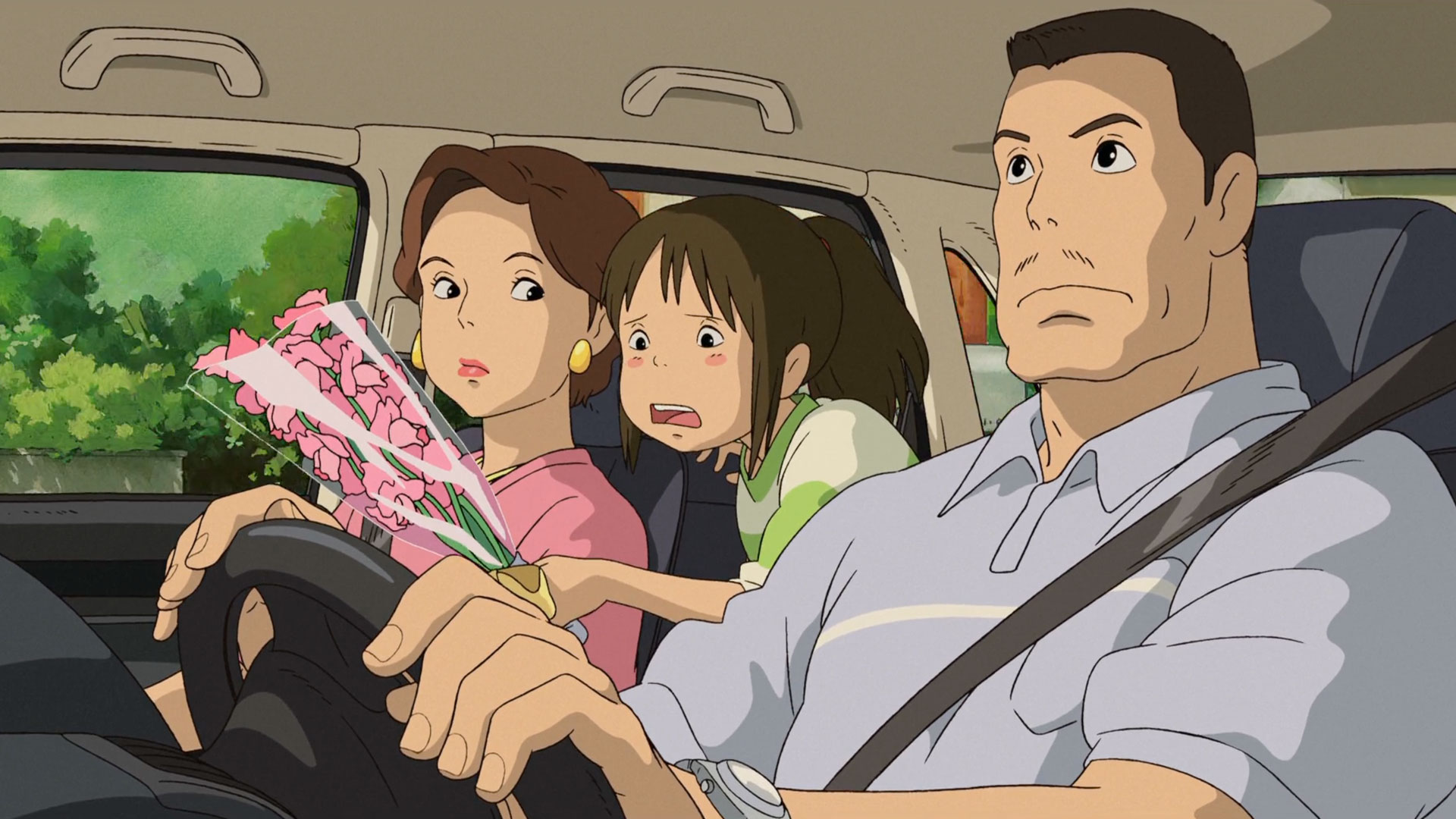
The story opens with ten-year-old Chihiro (千尋) and her family in the middle of a move to a new town. Chihiro is visibly upset about having to leave behind her friends and her old life. During the drive, her father decides to take an unfamiliar shortcut, assuming it will get them to their new home faster. Instead, the detour leads them to a mysterious clearing marked by a peculiar stone statue, which stands guard in front of a dark, tunnel-like entrance.

As Chihiro steps closer, a gust of wind pulls a cascade of leaves into the dark passageway. She immediately senses that something isn’t right, perhaps an instinct as old as humanity itself, the fear of the unknown and the unseen. She tries to convince her parents not to go in, but they won’t listen. With no other choice, she follows them inside.
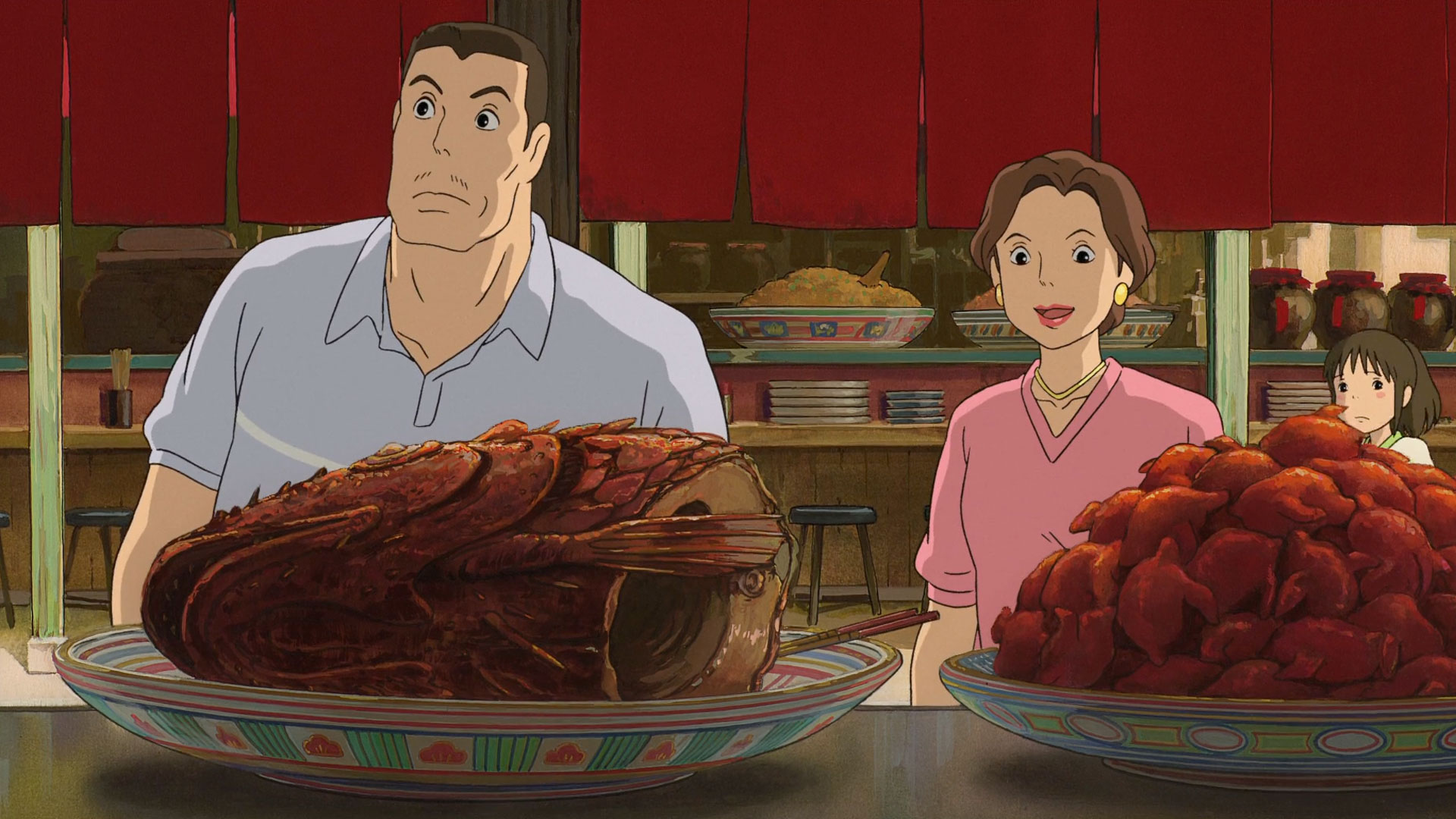
On the other side, Chihiro emerges into a vast open field, lined with what appear to be long-abandoned buildings. Drawn by the smell of food, her parents follow their noses into a deserted town, where steaming dishes sit out with no one around. Without a second thought, they dig in, assuming the owner has simply stepped away and that they can settle the bill when the owner returns.
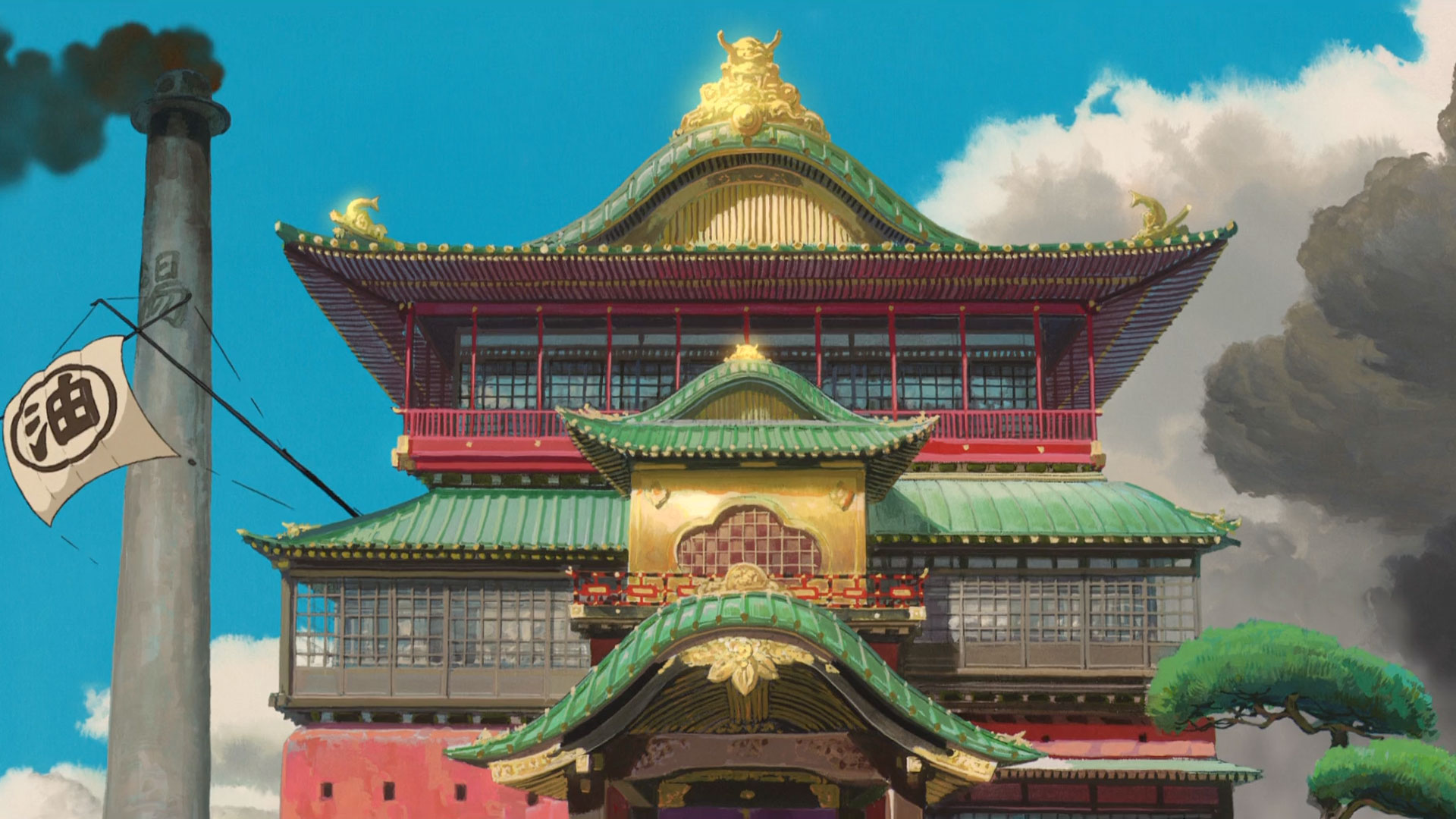
Meanwhile, Chihiro wanders off to explore and comes across a massive building. There, she runs into a mysterious boy, Haku (ハク), who seems genuinely shocked to find her. He suddenly shouts at her to turn back and leave the area before night falls. Puzzled, Chihiro heeds his warning and rushes back to get her parents. However, when she reaches the food stall where she left them, she discovers to her horror that they have transformed into giant pigs.
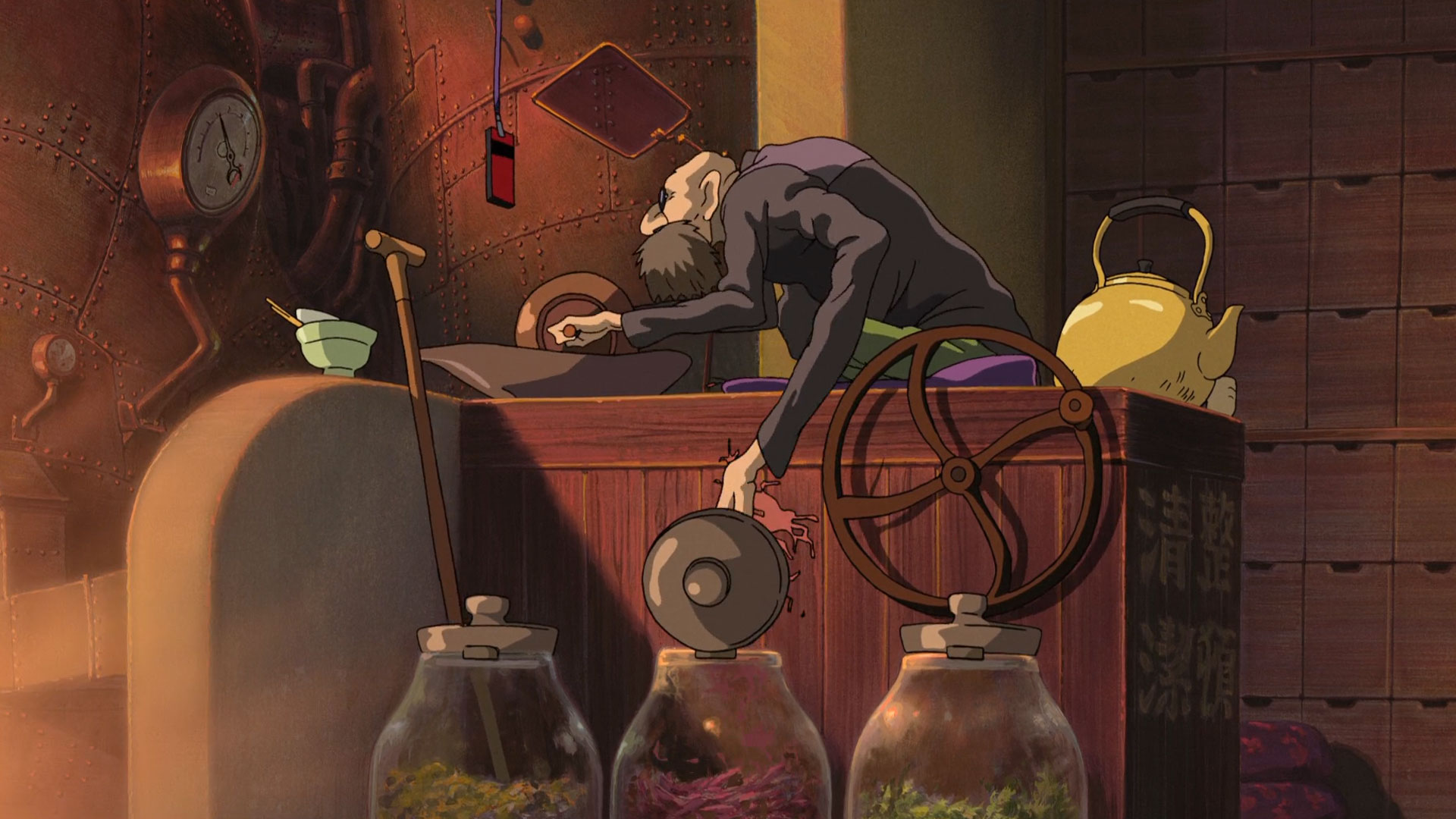
With Haku’s help, Chihiro meets Kamaji (釜爺), the boiler room operator, and Lin (リン), a young woman who works at the bathhouse. Eventually, she comes face to face with Yubaba (湯婆婆), the intimidating witch who rules over the entire establishment.
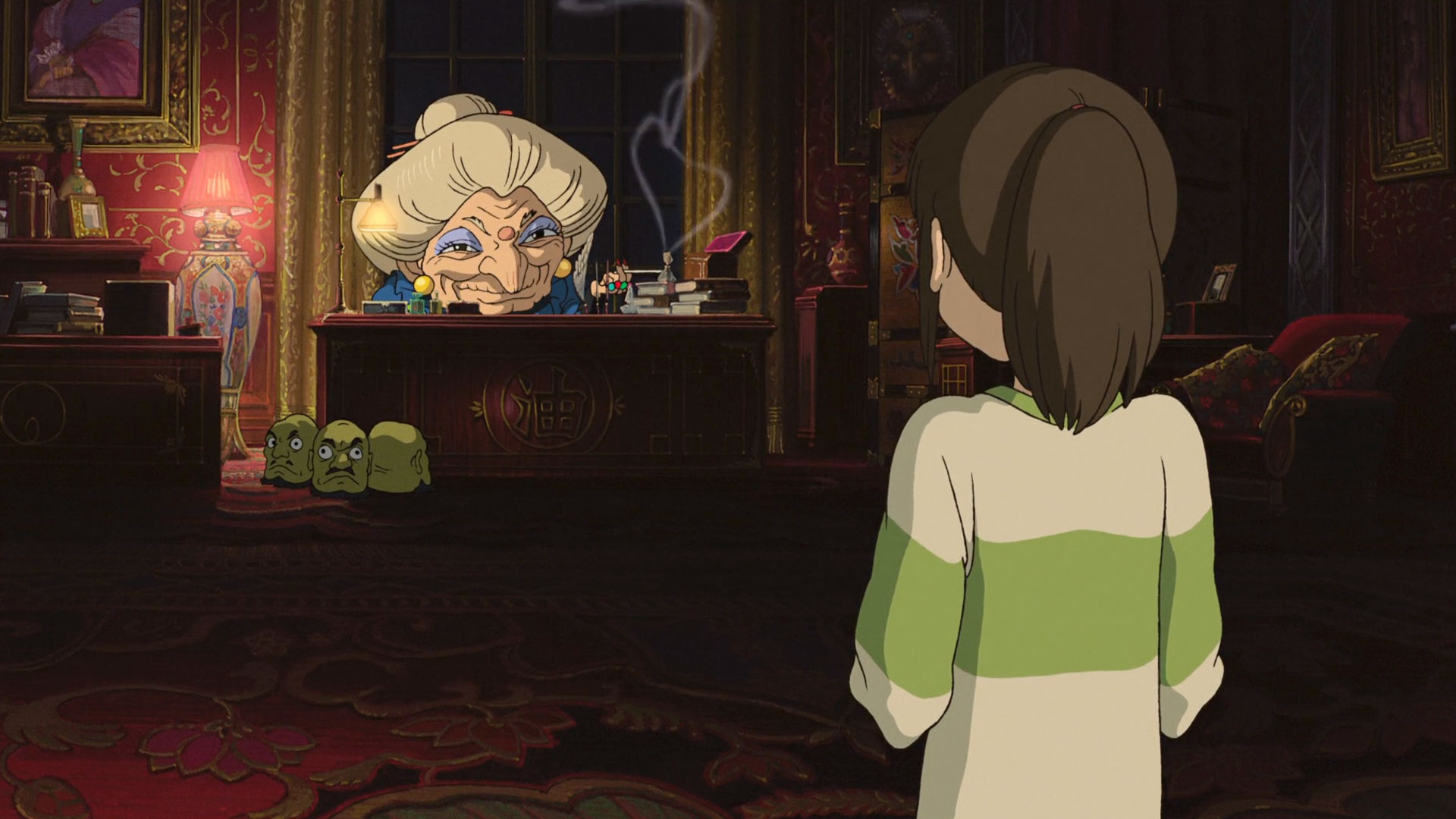
Following Haku’s warning that she must find work if she wants to survive, Chihiro is forced to get a job at the bathhouse. She sees this as her only chance to find a way to save her parents.
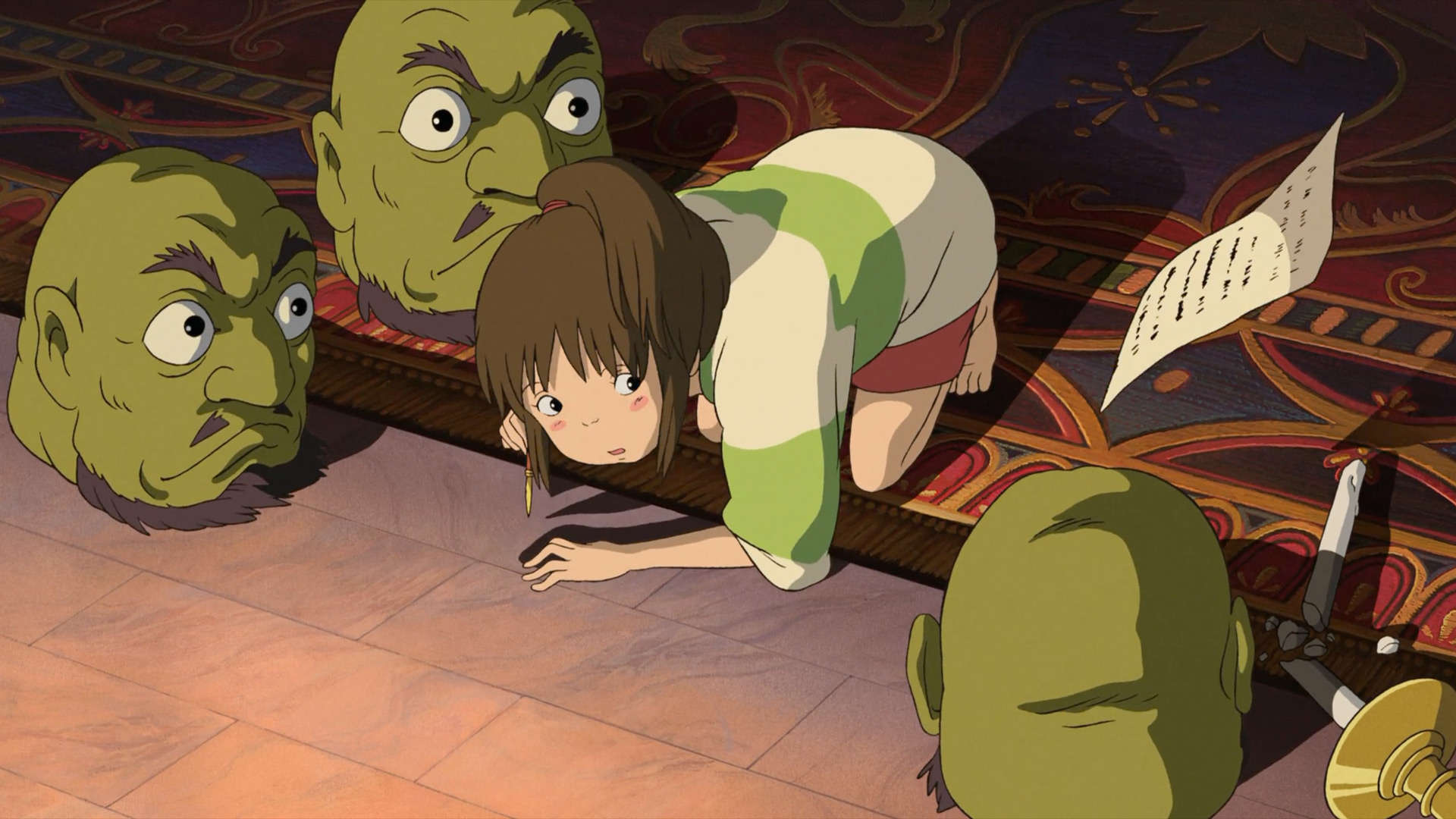
When Chihiro signs a contract with Yubaba, the witch magically strips away part of her name, leaving her with only one character: 千 (Sen). This draws on the mythological belief that when a person loses their name, they lose their soul along with it. As Chihiro’s name is taken, her memories begin to fade and she slowly loses her sense of self, without even realizing it.
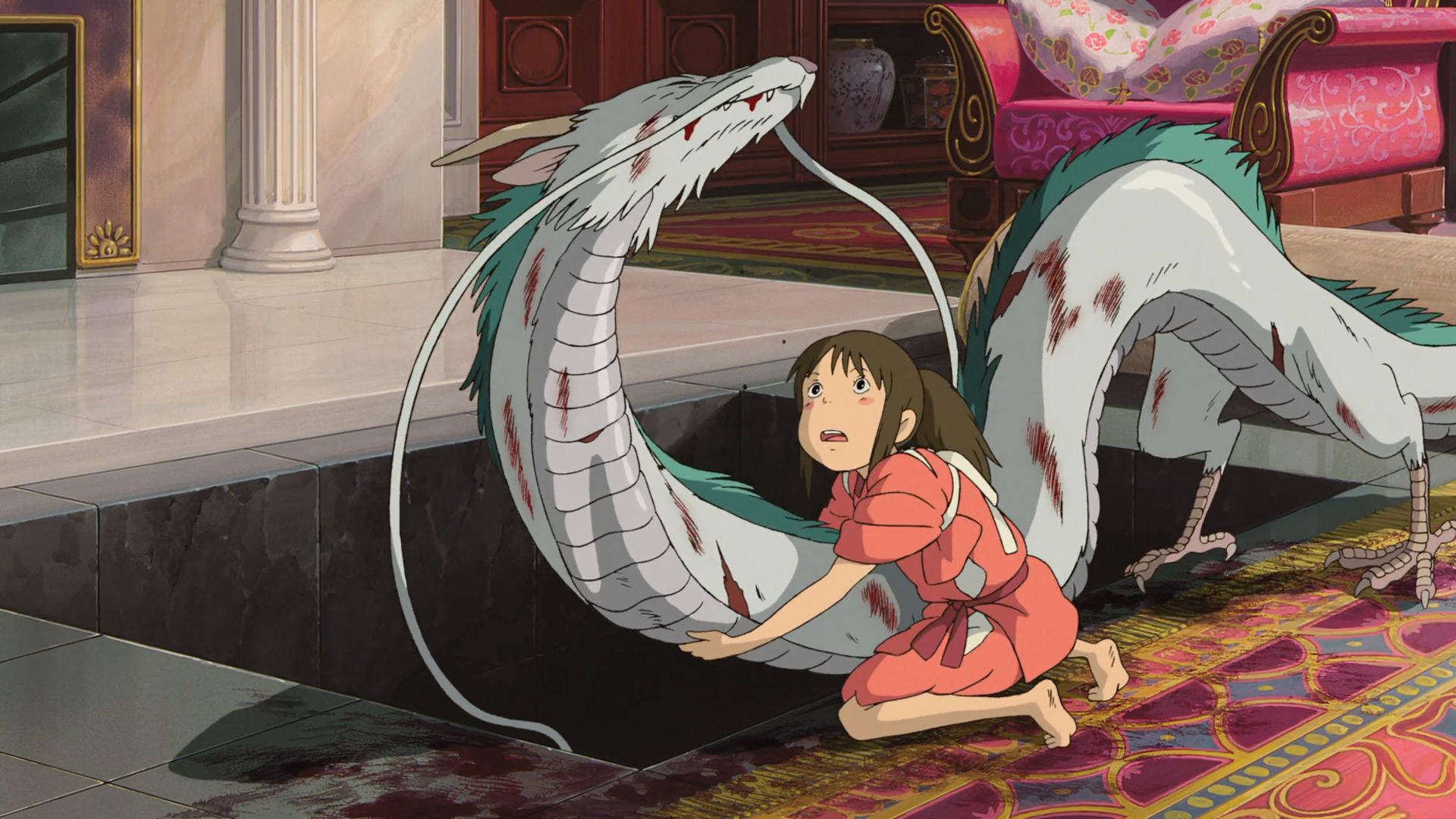
Chihiro later learns that Haku, like her, is under Yubaba’s control. This time, Yubaba has sent him to steal the golden seal belonging to Zeniba (銭婆), Yubaba’s twin sister. However, he has been wounded by the protective spell guarding it.
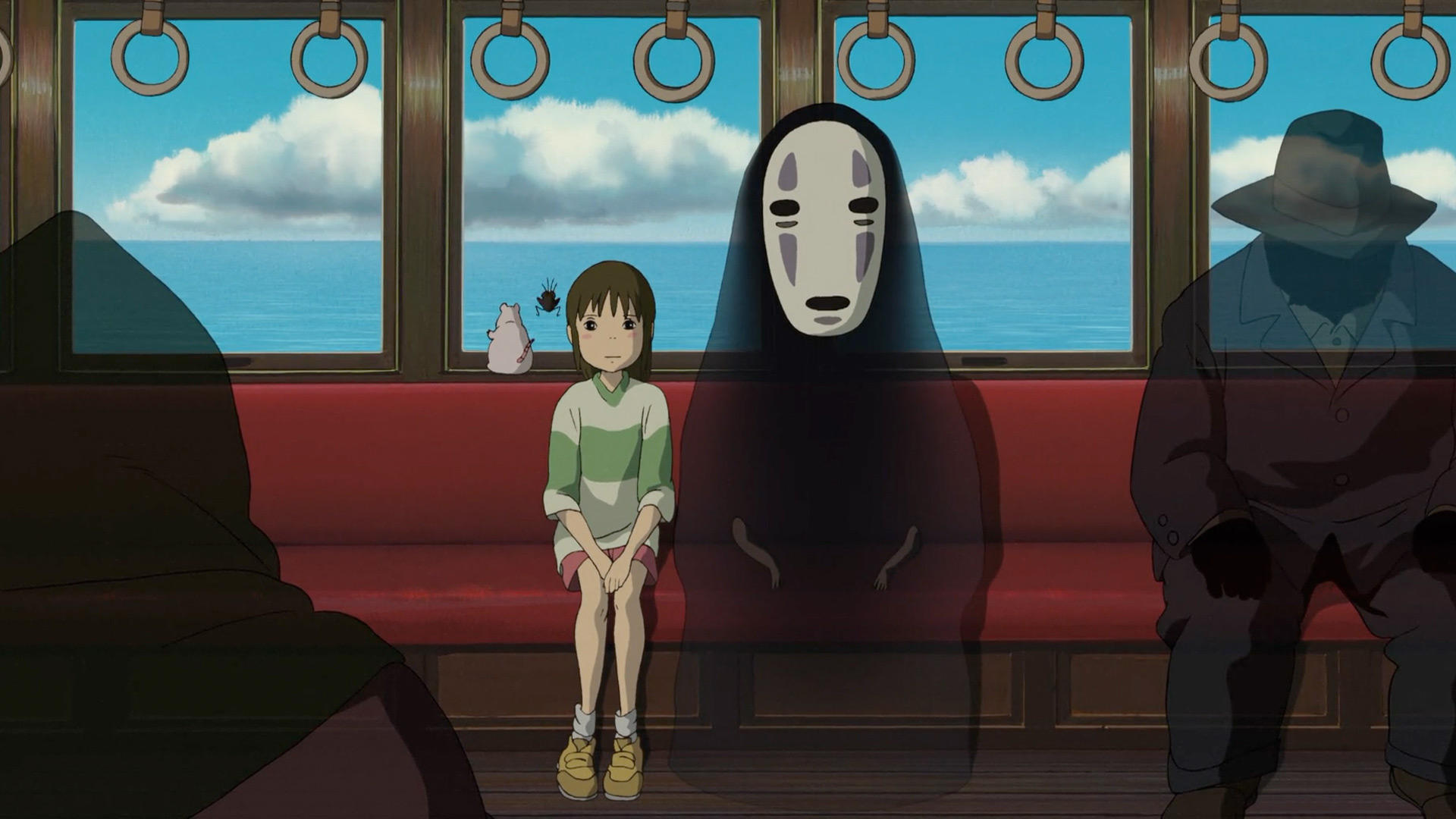
Chihiro sets out to return the seal to Zeniba, accompanied by three unlikely companions: a reformed No-Face (かおなし), who has returned to his gentle self with Chihiro’s help, Yubaba’s giant baby who has been cursed into the form of a small mouse, and a funny little bird. As they journey through the mystical landscape, the unlikely group discovers profound truths about life, compassion, and enduring friendship.
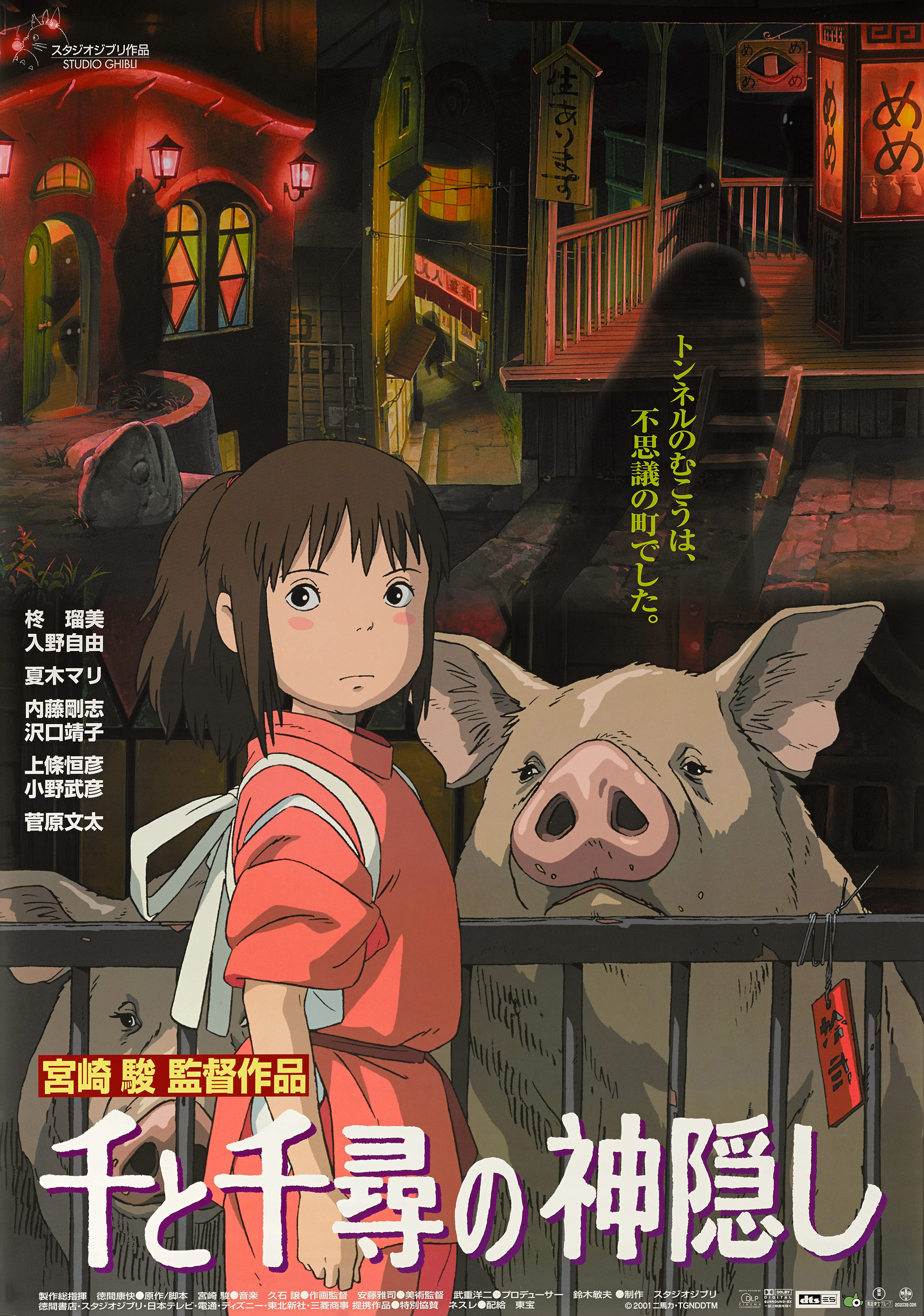
SPIRITED AWAY was theatrically released in Japan on 20 July 2001. The film received widespread critical acclaim and grossed over $395 million worldwide. In Japan alone, it raked in an astounding 31.68 billion yen. This made it the highest-grossing film in Japanese history, a record it held unchallenged for 19 years until 劇場版「鬼滅の刃」無限列車編 (DEMON SLAYER THE MOVIE — MUGEN TRAIN) finally claimed the title in 2020.


トンネルのむこうは、不思議の町でした。
—
A film by Hayao Miyazaki, featuring the voices of Rumi Hiiragi, Miyu Irino, Mari Natsuki, Takashi Naito, Yasuko Sawaguchi, Ryunosuke Kamiki, Yoomi Tamai, Yo Oizumi, Koba Hayashi, Tsunehiko Kamijo, Takehiko Ono, and Bunta Sugawara.

SPIRITED AWAY is frequently cited as one of the best films of the 21st century and stands as one of the greatest animated movies ever made. It made history by taking home the Oscar for Best Animated Feature at the 75th Academy Awards. For over two decades, it held the incredible distinction of being the first and only hand-drawn, non-English-language film to win this prestigious award, a record it kept until Hayao Miyazaki himself won the exact same award a second time in 2024 for his acclaimed film, the BOY and the HERON (君たちはどう生きるか).
Four years after Princess Mononoke (もののけ姫), SPIRITED AWAY was released to the world. The film’s protagonist is Chihiro, a ten-year-old girl who is quiet, a little listless, and not particularly fond of socializing. Chihiro is based on a real person: the young daughter of one of Miyazaki’s closest friends. Miyazaki owns a mountain retreat in Shinju, where he would invite his friends and their children to stay every summer.
It was during one of these visits that Miyazaki found his inspiration. “Until now, I have never made a film for ten-year-old girls,” he said. “She seems happy and full of energy right now, but as she grows up in this world, will she be able to hold onto that?” This became the driving force behind the film. “I will make this movie for her,” he decided. And since the girl who inspired him was ten years old, so too was Chihiro.
When the girl’s parents watched the film for the first time, they were struck by how perfectly Miyazaki had captured their daughter’s spirit. Her mother remarked that he must have been quietly observing her all along. In fact, this is something of a pattern for Miyazaki, as many of his characters are drawn from real people. Kiki, the protagonist of Kiki’s Delivery Service, for instance, was inspired by the thirteen-year-old daughter of Suzuki, the film’s producer.
Chihiro’s father was based on the real-life father of the girl who inspired the film. The resemblance is striking: he has a habit of getting lost while driving, as seen early in the film, and tends to eat in a rather unrefined, almost gluttonous way. Meanwhile, Chihiro’s mother, was modeled after a member of the Studio Ghibli staff, and shares one very specific trait with her real-life counterpart: the habit of propping her elbows up while eating. It is said that anyone who comes within ten feet of Miyazaki might one day find themselves immortalized as one of his characters, and looking at the evidence, that seems entirely believable.
The eerily deserted town featured prominently in the film’s opening is based on a real place: the Edo-Tokyo Open Air Architectural Museum, located near Studio Ghibli. The museum preserves historic buildings dating from the late 1700s through the mid-1990s and is open to the public. Miyazaki was a frequent visitor and returned whenever he had the chance. In the film, Chihiro stumbles into a hidden town that no one has ever found, a world running parallel to her own. In essence, it is a vision of Japan’s past.
Studio Ghibli is based in Koganei, on the outskirts of Tokyo, where many of its masterpieces have been brought to life, including Princess Mononoke. At the heart of the animation process is the art department, responsible for producing the enormous number of drawings that come together to create fluid motion on screen. Skilled artists draw each frame by hand, one at a time. While computer technology has since been incorporated into the workflow, the fundamental process remains unchanged: an animator first draws the key frames, defining the primary movements, and then passes them on to a team of in-between artists, who fill in the frames that bridge each key movement.
The storyboard is the heart of any Miyazaki film. Every idea born from his imagination is captured there, and his team gathers to study each panel together, discussing how movements should look and feel: the way a dragon’s body lands on the ground, or how a mouth should look when pulled open, with the gums and teeth exposed. Everyone works tirelessly to bring it all to life on schedule.
Once the animation is complete, it is time to record the voices. Beneath Studio Ghibli 2 lies a screening room, which for Spirited Away was converted into a recording studio, allowing Miyazaki to move freely between the voice recording sessions and the ongoing animation work. But this studio was unlike any other: there was no soundproof glass separating the voice actors from the rest of the team.
Silence, therefore, was everything. With nothing to buffer the sound, every noise in the room was picked up by the microphone. Even Miyazaki, with over twenty years in the industry, had never encountered a recording setup quite like it. “In that room, I could barely breathe,” he said. “It was nothing like a normal recording studio. I found myself anxious about every little sound, even the growling of my own stomach.
The titular role of Chihiro was voiced by Rumi Hiiragi (柊瑠美), a young actress who had previously made her mark in the NHK drama Suzuran (すずらん~少女・萌の物語~) at the age of 13. Opposite her is Mari Natsuki (夏木マリ), who provides the voice for the avaricious, harsh, and foul-mouthed witch, Yubaba. Despite the character’s intimidating demeanor, Natsuki brilliantly conveys her softer, doting side when interacting with her son. Her highly expressive vocal performance infuses Yubaba with a vivid, unforgettable charisma.
Shuji Inoue served as the sound engineer for the film. To capture authentic audio, he and the Studio Ghibli team traveled to Kusatsu Onsen to record real-life sound effects. In animation, the ambient noises are just as crucial as the voice acting. Because the story takes place in a bathhouse, the sound of water was incredibly important, and they found the perfect audio at this specific hot spring. Typically, Inoue would mix audio back at the studio, but since the main sound effects team was tied up with production delays, he and a few crew members went out to gather the necessary recordings themselves. They were not simply after the sound of flowing water; they needed the full sonic texture of a bathhouse: scrubbing, footsteps, wooden buckets clacking together, water being poured, splashing, and more.
The team’s dedication to realism didn’t stop there. For the bathhouse kitchen scenes, they visited an actual restaurant to record the sounds of stir-frying, boiling water, sizzling oil, chopping vegetables, and the muffled voices behind partitions. They even went so far as to rent the exact make and model of the car Chihiro’s father drives, recording the engine as they drove it over rough, unpaved roads to match the movie’s opening scene. Back at the Tokyo studio, the Foley team meticulously recorded finer details. They experimented with different types of shoes on various surfaces, splashing through puddles, and running down stairs. They even wore mismatched shoes and used different gaits to create a wide, realistic variety of footsteps.
For the film’s monumental orchestral score, Studio Ghibli rented out the Sumida Triphony Hall in Tokyo. The soundtrack was composed by the one and only Joe Hisaishi, the legendary musician behind every single one of Hayao Miyazaki’s films since Nausicaä of the Valley of the Wind. His majestic melodies were performed by the esteemed New Japan Philharmonic. In their pursuit of absolute acoustic perfection, the production team utilized an astonishing array of 60 microphones to capture the symphony’s breathtaking performance.
By June, just one month before the film’s theatrical release, the voice acting was finally drawing to a close. Miyu Irino (入野自由), who voices the mysterious boy Haku, joined Rumi Hiiragi in the booth for the very last day of character recording. Following this concluding session, all the vocal performances were transferred to the studio for the final audio mix.
The film’s iconic theme song, “Always with Me” (いつも何度でも), left such a profound impact on Hayao Miyazaki that some say it directly inspired the creation of the movie itself. Composed and performed by Yumi Kimura (木村弓), a talented musician who plays a harp-like instrument called a lyre, the track became Miyazaki’s constant companion, playing continuously in his studio as he worked.
Kimura’s journey with Studio Ghibli began after she watched Princess Mononoke (もののけ姫). Deeply moved, she wrote a heartfelt letter to Miyazaki expressing her dream of contributing her music to one of his films. To her surprise, Miyazaki wrote back, even sharing a few details about his upcoming project.
Later, Kimura composed a melody she was particularly fond of. Though she wasn’t sure if it fit his new film, she hoped he would enjoy it and sent him a tape. At the time, Miyazaki was working on a project called Rin the Chimney Painter (煙突描きのリン). He replied to let her know he adored the song, but unfortunately, the Rin project had been scrapped. While Kimura was slightly disappointed, she was thrilled that he loved her work. They lost touch for a while as Miyazaki shifted his focus to a new project: Spirited Away. During this creative process, he revisited Kimura’s tape. Listening to it again, he was struck. Her song felt perfectly in tune with the story he was woking on.
As children grow into adults, they often forget what it truly feels like to be young. This message seems to be exactly what a specific part of the song is trying to convey. Because it captured that fleeting feeling of childhood so perfectly, Miyazaki ultimately decided to use the track as the film’s beautiful closing theme.
SPIRITED AWAY is one of the most wildly successful anime films in Japanese history, achieving an unprecedented level of acclaim. The film has swept up awards around the world, and its breathtaking imagination continues to captivate audiences of all ages. The visionary behind this magic is Hayao Miyazaki, whose unique perspective has earned him the immense respect of animators and filmmakers across the globe. He remains one of the greatest living creators in the medium, and Spirited Away stands as one of the most powerful expressions of his boundless imagination.
At its core, SPIRITED AWAY is the story of a young girl trapped in a mysterious, otherworldly realm. To survive, she must dig deep and discover her own inner strength. She soon realizes that her only chance of making it out alive is to secure a job at a magical bathhouse, a sanctuary designed to rejuvenate weary spirits. As she navigates this bizarre workplace, the audience is treated to a dazzling parade of ethereal beings from Miyazaki’s brilliant mind.
Most viewers assume that characters like the stinking sludge spirit, later revealed to be a river spirit wounded by pollution, were drawn from ancient Japanese folklore. In reality, many of Miyazaki’s characters were inspired by real-life experiences. Of this particular character, he has said: “I once helped clean up a river, and there really was a bicycle submerged in it, buried under the mud. There were ten of us, and we slowly pulled the handlebars out together. Once we finished cleaning the river, the fish came back. That’s why I put that scene in the film.”
Even a character like No-Face (かおなし, combining 顔 “kao,” meaning face, and 無し “nashi,” meaning without) reflects something very real. No-Face exploits the greed of those around him to work his way into their minds. While most characters in the film carry a sense of Miyazaki’s positive outlook, No-Face stands apart as a force of negative energy, doing whatever it takes to burrow into the hearts of others.
Miyazaki built a world of breathtaking visuals and perfectly matched sound, one that has inspired animators around the world. In the United States, animation is typically divided among many specialists: writers, directors, artists. Miyazaki does it all himself. From the screenplay to the direction to the drawings, everything flows from his imagination alone. He storyboards the entire film by hand from beginning to end, and on top of that, he also writes the lyrics to the songs.
Beyond his remarkable vision, Miyazaki pays close attention to the small, ordinary details of everyday life, the kind of things so unremarkable that most of us never notice them. But nothing escapes Miyazaki’s eye, and it is precisely these details, woven into his characters, that give them such an irresistible charm.
In one scene, we see Chihiro slipping her feet into her shoes. A lesser animator might have simply drawn her putting them on and running off, but Miyazaki observed how real girls actually do this. A girl wants to make sure her shoes are on properly before she moves. So in his version, Chihiro taps the toe of each shoe against the ground to make sure they are snug and won’t slip off when she walks or runs. It is a tiny moment, but it quietly reminds the audience that this is not a fantasy world detached from reality. It feels lived in and true.
Then there is the scene where Chihiro follows Haku across the bridge to the bathhouse. She must hold her breath the entire way so as not to be detected as a human intruder. We see her reach up and pinch her nose shut, exactly what a real child would do when they believe their life depends on not letting a single breath escape. Moments like these prove that Miyazaki truly understands the authentic minds and hearts of children.
Every one of Miyazaki’s films features at least one scene of flight, a moment that feels almost magical, lifting the audience into something beyond the ordinary. Even the legendary animators at Disney were not immune to his influence. The iconic sequence in Fantasia 2000, in which a pod of whales soars from the sea into the sky, was directly inspired by Miyazaki’s Kiki’s Delivery Service (魔女の宅急便).
Disney was not the first American company to try to bring Miyazaki’s work to Western audiences. For over twenty years, various studios had shown interest and made their attempts, but none succeeded. Studio Ghibli turned them all down. Then Disney stepped in with an offer that was different from everything that had come before: they wanted the rights to the entire Studio Ghibli library, and they agreed not to alter or cut a single frame of any film. It was an assurance no one else had given, and it was enough. Studio Ghibli finally said yes.
Under John Lasseter’s supervision, a top-tier team was assembled to handle the English voice recording and adaptation of SPIRITED AWAY. His goal was to bring Miyazaki’s vision to American audiences without changing a thing. The translators and screenwriters would gather in a screening room and work through the film scene by scene, searching for dialogue that felt natural and true to the original. Lines were revised again and again to match the movement of each character’s mouth, and sometimes the rewrites went through so many rounds that the dialogue began to lose its natural feel. On more than one occasion, the Disney team had to email Studio Ghibli in Japan directly to ensure that certain lines were being interpreted with complete accuracy.
John Lasseter is an acclaimed American animator, director, producer, and screenwriter renowned for pioneering computer-generated animation at Pixar. Born on January 12, 1957, he directed landmark films like Toy Story (1995), the first fully CGI feature film, along with A Bug’s Life (1998), Toy Story 2 (1999), Cars (2006), and Cars 2 (2011). After studying at the California Institute of the Arts, Lasseter began his career at Walt Disney Animation in the late 1970s, later joining Lucasfilm’s computer graphics division, which became Pixar in 1986 under Steve Jobs; there, he developed early CGI shorts like Tin Toy (1988), earning an Oscar. As Pixar’s chief creative officer until 2018, he oversaw films like Monsters, Inc. and Finding Nemo while also leading Walt Disney Animation Studios and Disneytoon Studios from 2006, blending CGI with storytelling.
One example is a scene between Chihiro and Kamaji that draws on a distinctly Japanese cultural tradition, something that would naturally go over the heads of American or international audiences. The English screenwriters found it fascinating but had no idea what it meant or what it was trying to convey. When they consulted the Japanese team, they learned it was a tradition called engacho (エンガチョ). When someone encounters something bad or unpleasant, they form a circle with the thumb and index finger of each hand and touch them together. Another person then karate-chops through the joined fingers to break the connection, which is believed to ward off the bad luck. Interestingly, even many younger Japanese people today are no longer familiar with the custom.
Another example involves the golden seal. In the original Japanese, the word used is simply “seal,” meaning a stamp or signet, which is a familiar object in Japan where personal seals are widely used in place of signatures. However, the English team worried that the word “seal” alone might confuse American audiences, since it also refers to the animal. In the scene, a small black worm-like creature wriggles around in a way that could easily be mistaken for a tiny seal. To avoid any confusion, the team added the word “golden,” making it clear that the object in question is a golden seal, the stamping kind, not the swimming kind.
Once the script was finalized, it was time for the voice cast to step in and bring the English version to life. The process was a little different from a typical Disney production. Since Spirited Away was already a completed film, the voice actors had to fit their performances precisely to the existing mouth movements on screen. This was the reverse of how Disney normally works: in their own animated productions, the voice actors record first, sometimes while the film is still being made, and the animators then draw the characters’ mouths to match the recorded dialogue.
Jason Marsden, the voice of Haku, described the experience this way: “The most difficult part for me was just having to put in my performance with someone else’s timing. If I were to do it, maybe I would have used this line and paused a while or embellished a certain way, but I can’t do that because the mouth is still moving and they’re not about to change that for me.”
Daveigh Chase, the voice of Chihiro, already known for her charming performance as Lilo in Lilo & Stitch, brought a natural, instinctive quality to her performance.
Suzanne Pleshette, the voice of Yubaba, spoke about her approach to the role: “I made some choices before I actually heard everything I’ve made the opposite choice of the Japanese actress because one sister she makes lighter, and the other she makes heavier. Somehow in my own mind, decided that their characters were the reverse.”
Susan Egan, the voice of Lin, the kind-hearted young woman who helps Chihiro, previously known for her work in Hercules, shared how different the two experiences were: “When I was doing Hercules, of course, there was no final product. There were some sketches and they showed me a picture of my character. But I think recording this way, I’m inspired by seeing the final animation, which is just gorgeous.”
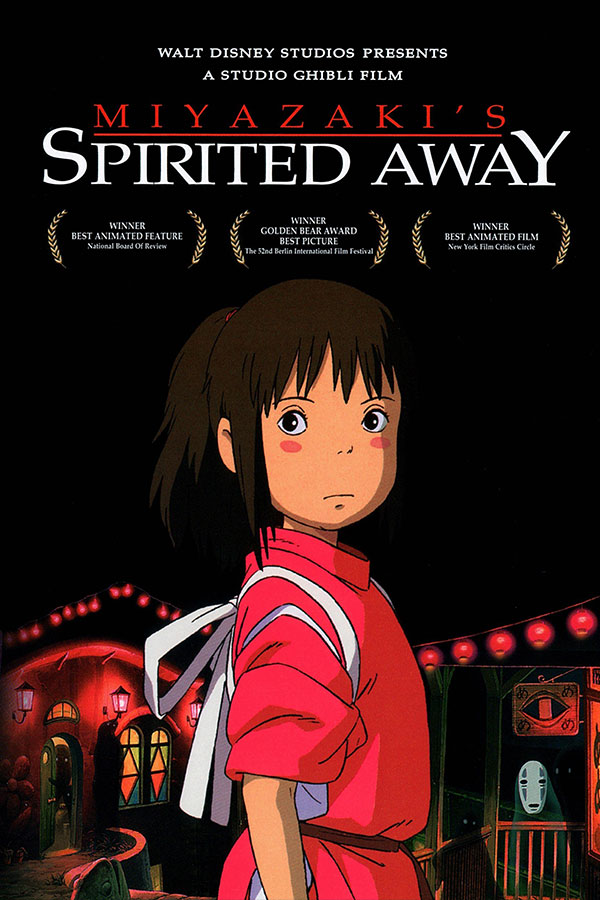
SPIRITED AWAY (2001)
千と千尋の神隠し
AWARDS
- Best Animated Feature Film; 75th Annual Academy Awards
- Best Film; 2001 Japanese Academy Awards
- Golden Bear (tied); 2002 Berlin International Film Festival
- Best Animated Feature; 2002 New York Film Critics Circle Awards
- Special Commendation for Achievement in Animation; 2002 Boston Society of Film Critics Awards
- Best Animated Feature; 2002 Los Angeles Film Critics Awards
- Outstanding Achievement in an Animated Feature Production; 2002 Annie Awards
- Best Directing in an Animated Feature Production; 2002 Annie Awards
- Best Writing in an Animated Feature Production; 2002 Annie Awards
- Best Music in an Animated Feature Production; 2002 Annie Awards
- Best Animated Feature; 2002 Critics’ Choice Awards
- Best Animated Feature; 2002 New York Film Critics Online Award
- Best Animated Feature; 2002 Florida Film Critics Circle
- Best Animated Feature; 2002 National Board of Review
- Best Original Score in the Category of Comedy or Musical; 78th Annual Glaubber Awards
- Motion Picture, Animated or Mixed Media; 7th Annual Golden Satellite Awards
- Audience Award for Best Narrative Feature; 45th San Francisco International Film Festival
- Special Mention from the Jury; 2002 Sitges Film Festival
- Best Asian Film; 2002 Hong Kong Film Awards
- Best Animated Film; 29th Annual Saturn Awards
- Best Film (tied); Cinekid 2002 International Children’s Film Festival
- Best Animated Feature; Online Film Critic Society
- Best Animated Feature; Dallas-Forth Worth Critics
- Best Animated Film; Phoenix Film Critics Society
- Silver Scream Award; 19th Amsterdam Fantastic Film Festival
- Best Family/Animation Trailer; Fourth Annual Golden Trailer Awards
- Brilliant Dreams Award 2003; Bulgari
- Award Winner, Film; 2003 Christopher Awards
- Award Winner, Most Spiritually Literate Films of 2002; Spirituality & Health Awards
- Best Movie for Grownups who Refuse to Grow Up, Best Movies for Grownups Awards; AARP The Magazine